Struggling to see the real value in e-bike features? A rear rack seems simple, but a poor design can create after-sales nightmares and limit your market reach.
A well-designed rear rack is crucial because it transforms an e-bike from a recreational item into a practical daily vehicle for commuting, cargo, or family use.1 As a B2B buyer, you should focus on its structural integrity, connection points, and accessory compatibility, not just its load rating.
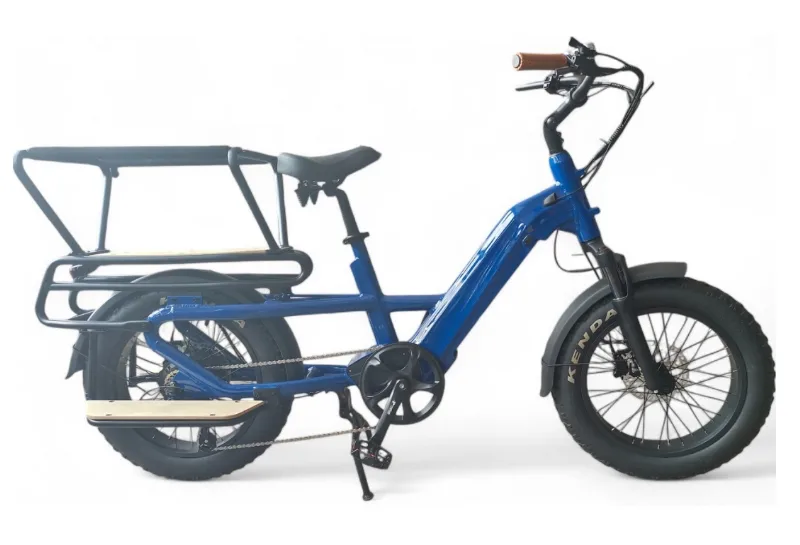
It's easy to overlook the details of a rear rack when you're focused on motors, batteries, and pricing. You might see it as a simple add-on, a box to check. But in my 20+ years of manufacturing, I've seen this single component make or break a product's success in the real world. Let's dig into what truly matters and what you should be asking your supplier.
Is the Rack Just for Show, or Is It Built for Real-World Loads?
You see an e-bike with a sturdy-looking rack and assume it's ready for anything. But what if it fails under a real load, damaging your customer's trust and your brand's reputation?
A structural, load-bearing rack is engineered as part of the bike, using strong connection points.2 In contrast, a decorative rack might look good but simply can't handle the daily stress from cargo or a child seat. The difference is critical for safety and long-term durability.
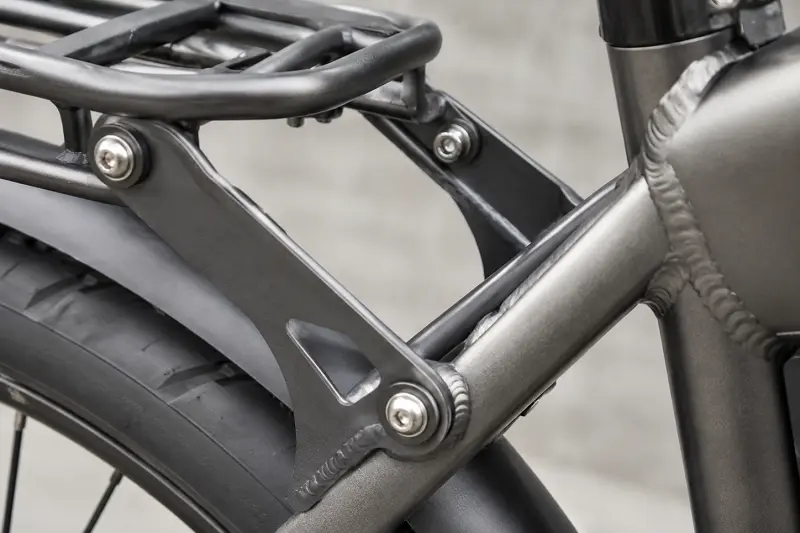
When I evaluate a rear rack, I'm not just looking at it; I'm analyzing its purpose. Is it a "decorative" rack meant only to make the bike look more practical, or is it a true "load-bearing" structure? Many B2B clients only ask about the price difference, but the real cost comes later. A decorative rack might be attached with small screws to weaker parts of the frame. It might hold a light shopping bag, but put a child seat or a heavy delivery box on it, and you're asking for trouble. The vibrations and dynamic forces from riding will quickly lead to loose screws, rattling noises, and eventual failure.3 A structural rack, however, is designed with the frame. It often connects to reinforced eyelets on the dropouts and seat stays, or is even welded directly onto the frame for maximum stability.
| Feature | Decorative Rack | Structural Rack |
|---|---|---|
| Connection | Bolted to non-reinforced points | Integrated with frame or bolted to reinforced dropouts |
| Material | Thin-walled, lightweight tubing | Thicker, high-strength alloy or steel |
| Primary Purpose | Aesthetics, carrying very light items | Heavy cargo, child seats, delivery boxes |
| Long-Term Risk | Loosening, rattling, structural failure, safety hazard | Stability, safety, long-term reliability |
Does the Rack Design Limit or Expand the E-Bike's Versatility?
You've sourced an e-bike with a rack, thinking it adds value. But then customers complain they can't fit a standard child seat or their favorite pannier bags. The bike's potential is wasted.
A truly versatile rack is designed for compatibility.4 It must have standard mounting points for accessories like baskets, child seats, and panniers without interfering with the bike's other functions. This design thinking directly increases the e-bike's market appeal and real-world use cases.
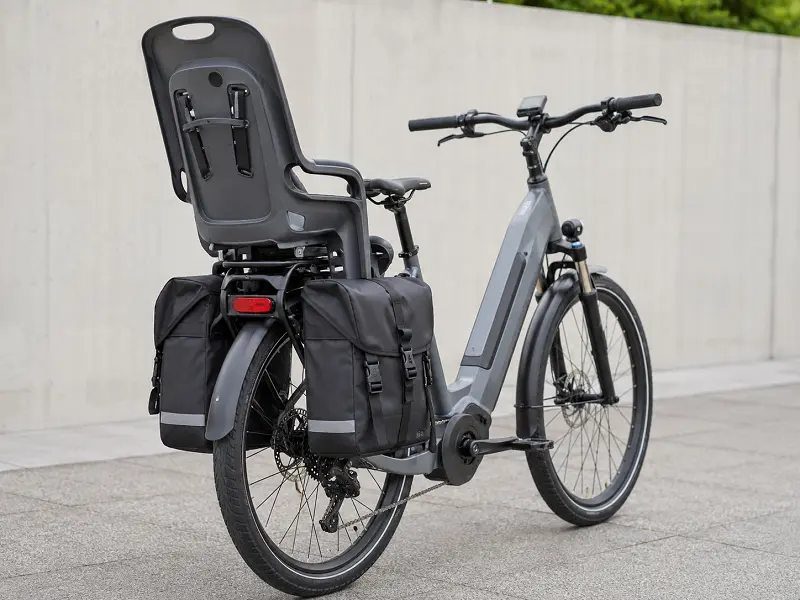
A rear rack's value isn't just about what it can carry, but also what it allows the end-user to do. For city, cargo, and family e-bikes, the rack is the gateway to functionality. I always check if the design allows for a wide range of accessories. Can a user easily mount a standard child seat without it hitting the saddle?5 Is there enough heel clearance so their feet don't hit the pannier bags while pedaling? These details matter. I also look for potential interference. A poorly placed rack can make it difficult or impossible to remove the battery for charging.6 It might also block the taillight or pinch the wiring harness, creating maintenance headaches. I once had a project where the rack design was an afterthought. We discovered late in development that installing a popular child seat model put dangerous pressure on the battery casing. We had to re-tool the entire rack, which caused significant delays and costs. This is why I now insist on checking these compatibility details from the very first prototype. A good rack design considers the entire ecosystem of the bike, not just its own function.7
Are You Only Looking at Load Capacity and Forgetting the Real Safety Risks?
A supplier tells you the rack is rated for 25 kg, which sounds great. But this number can be misleading and can hide serious long-term safety and maintenance issues for your brand.
A simple weight rating doesn't tell the whole story. The real safety factor lies in how the rack connects to the frame and how it performs under dynamic loads from vibrations and bumps.8 Weak connection points are a major source of after-sales complaints and a serious safety liability.
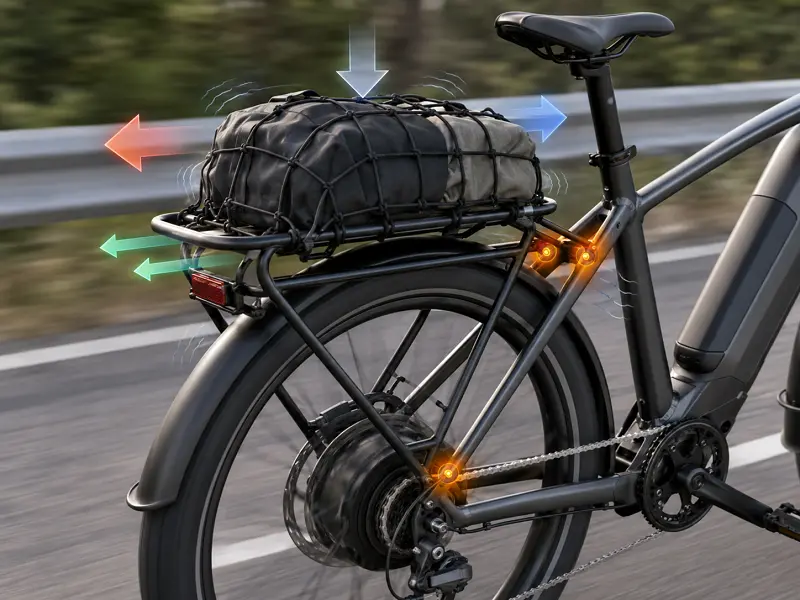
The "25 kg" load rating is often for a static, perfectly distributed weight. Real-world usage is never like that. A child shifts their weight, or a delivery box bounces violently when the bike hits a pothole. These are dynamic loads, and they put much more stress on the rack and its mounting points than a static weight. This is where I see the biggest risks. I always inspect the connection points closely. Are the bolts high-tensile strength with locking washers to prevent them from vibrating loose? More importantly, what are they bolting into? The eyelets on the e-bike frame must be reinforced. A simple hole drilled into a frame tube is a weak point that can fatigue and fail over time.9 When a rack is welded directly to the frame, I check the quality of the welds to ensure they are clean and have full penetration. Remember, an e-bike is heavier and faster than a regular bicycle. A rack failure at 25 km/h is far more dangerous than one on a casual cruiser.10 This isn't just about a wobbly rack; it's a real liability risk that you, as the B2B buyer, must consider to protect your customers and your brand.
Conclusion
A rear rack is not just an accessory; it is a core feature that defines an e-bike's practical value and safety.11 Look beyond price and focus on its structural design.
"Ebike Rear Racks - Retrospec", https://retrospec.com/collections/ebike-rear-racks?srsltid=AfmBOoopqqFEvPO4eaCvGqhZ0sG12uDpAUdcRC6o36cUUo-kmQTtSTfc. This source explains how rear racks enhance e-bike functionality for commuting and cargo use, providing examples of practical applications. Evidence role: general_support; source type: encyclopedia. Supports: Rear racks transform e-bikes into practical daily vehicles for commuting, cargo, or family use.. ↩
"[PDF] San Francisco Space Saving Bike Rack - Scholar Commons", https://scholarcommons.scu.edu/cgi/viewcontent.cgi?article=1114&context=mech_senior. This source describes the engineering principles behind structural, load-bearing racks and their integration with e-bike frames. Evidence role: mechanism; source type: education. Supports: Structural racks are engineered as part of the bike using strong connection points.. ↩
"Is Your Electric Bike Rack Really Safe for a 70+ lb E-Bike - CRAVOT", https://cravot.com/blogs/news/is-your-electric-bike-rack-really-safe-for-a-70-lb-e-bike?srsltid=AfmBOopmfpTh_b7bDAyhTBkJCUknWNGTdHxgLvpD1wDBTPB_J571kA2U. This source discusses how dynamic forces during riding can lead to structural issues in e-bike racks, including loose screws and failure. Evidence role: mechanism; source type: research. Supports: Dynamic forces during riding cause structural issues like loose screws and eventual rack failure.. ↩
"10 Best Bike Racks For Electric Bikes 2025 | Hitch, Truck, Car, RV ...", https://www.youtube.com/watch?v=7sEwnAPpVqY. This source outlines the design features that make e-bike racks compatible with various accessories, enhancing their versatility. Evidence role: definition; source type: research. Supports: Versatile racks are designed for compatibility with accessories like child seats and panniers.. ↩
"Best Baby & Child Bike Seats (2026): Tested & Reviewed", https://www.twowheelingtots.com/best-child-bike-seats/. This source provides guidelines for designing e-bike racks that accommodate child seats without interference with the saddle. Evidence role: case_reference; source type: education. Supports: E-bike racks should allow mounting of child seats without interference with the saddle.. ↩
"How to resolve ebike rack installation issues with folding bike posts ...", https://www.facebook.com/groups/926685377947023/posts/1699833057298914/. This source highlights design flaws in e-bike racks that interfere with battery removal, providing examples of poor placement. Evidence role: case_reference; source type: research. Supports: Poorly placed racks can obstruct battery removal for charging.. ↩
"Bike Rack Design and Spacing Guidelines - Portland.gov", https://www.portland.gov/transportation/walking-biking-transit-safety/bikerackdesignspacing. This source explains how rack designs should integrate with the overall e-bike ecosystem, including accessory compatibility and frame design. Evidence role: definition; source type: research. Supports: Good rack designs integrate with the entire e-bike ecosystem, enhancing functionality.. ↩
"What impact does a bike hitch rack have on electric bike range?", https://www.facebook.com/groups/equinoxev/posts/3718364111786919/. This source discusses the impact of dynamic loads on e-bike racks and the importance of secure frame connections for safety. Evidence role: mechanism; source type: research. Supports: Safety factors for racks depend on frame connections and performance under dynamic loads.. ↩
"I think this is a flaw in the design of this ebike. - Reddit", https://www.reddit.com/r/ebikes/comments/1folyob/i_think_this_is_a_flaw_in_the_design_of_this_ebike/. This source explains how drilled holes in frame tubes can lead to fatigue and failure, especially under dynamic loads. Evidence role: mechanism; source type: education. Supports: Drilled holes in frame tubes are weak points prone to fatigue and failure over time.. ↩
"How Fast Can You Drive With a Bike Rack? Speed Guide - Tooenjoy", https://tooenjoymall.com/blogs/blog/how-fast-can-you-drive-with-a-bike-rack-speed-guide?srsltid=AfmBOopXx3WjsRbrujF4pi8ImmKoM5lBoQOjhtQpJG_1JNi4mZpZdCPT. This source discusses the increased risks of rack failure at higher speeds, particularly for e-bikes compared to casual cruisers. Evidence role: statistic; source type: research. Supports: Rack failures at higher speeds pose greater safety risks, especially for e-bikes.. ↩
"How important is a rear rack on an e-bike? - Facebook", https://www.facebook.com/groups/huntingebikesbuyselldiscuss/posts/1600700270793995/. This source elaborates on how rear racks contribute to the practical value and safety of e-bikes, emphasizing their importance. Evidence role: general_support; source type: encyclopedia. Supports: Rear racks are core features that define an e-bike's practical value and safety.. ↩