Are your e-bikes getting feedback about jerky, unnatural motor assistance? This problem can make a bike feel cheap. A torque sensor is the solution that creates a premium feel.
A torque sensor makes an e-bike ride feel incredibly natural and intuitive.1 It measures your actual pedaling force and provides a proportional amount of motor assistance. This means the bike helps you more when you pedal harder, creating a smooth, responsive experience unlike basic on/off sensors.
You might think specs like motor power or battery range are all that matter to customers. But I've learned that the actual feel of the ride is what creates a lasting impression. This is where the torque sensor truly shines. It’s a subtle component, but it completely changes how a rider connects with their bike. It's a key part of what makes a good bike feel great. Let's explore how this technology works and why it's a game-changer for your e-bike line.
How Does a Torque Sensor Actually Work Compared to a Cadence Sensor?
Do your customers complain that their e-bike feels like it's either "on" or "off"? This abrupt power delivery can be jarring. A torque sensor eliminates that jerky feeling entirely.2
A torque sensor measures how hard you're pushing on the pedals and tells the motor to provide assistance that matches your effort. In contrast, a cadence sensor just checks if you are pedaling, then turns the motor on to a preset level, creating a less refined ride.
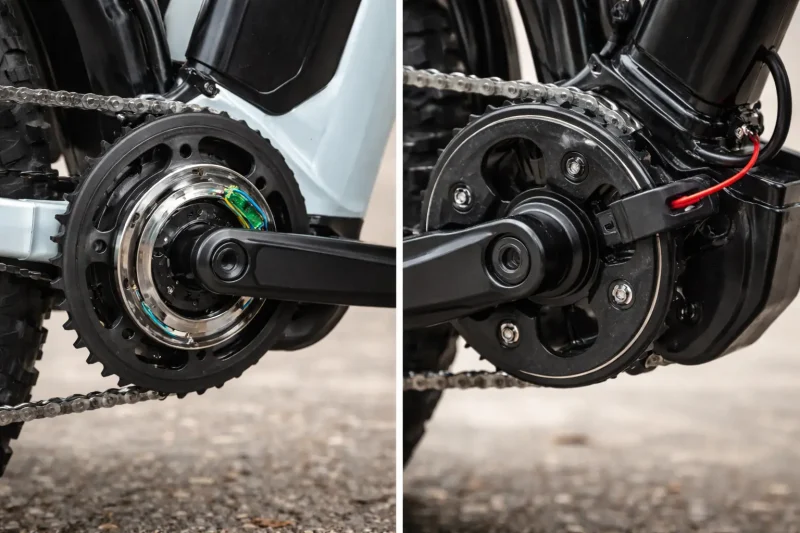
To really understand the value, it helps to see how different they are. In my experience manufacturing thousands of e-bikes, the choice between these two sensors defines the character of the final product.
The Cadence Sensor: A Simple Switch
Think of a cadence sensor as a light switch. It detects if the pedals are turning or not. It uses a ring of magnets on the crank arm and a sensor on the frame. As you pedal, the magnets pass the sensor, which signals the motor to turn on. The motor then provides a fixed level of assistance based on the setting you chose. It's simple and cost-effective, but it can feel abrupt. The bike can lurch forward when you start pedaling and the power can feel disconnected from your effort.
The Torque Sensor: An Intelligent Partner
A torque sensor is much more sophisticated. It's like a dimmer switch. It measures how much force, or torque, you are applying to the pedals. It's usually located in the bottom bracket and has a precise strain gauge. As you pedal harder, the gauge flexes slightly, and the sensor translates this into a signal for the motor controller. The controller then delivers a proportional amount of power. Pedal lightly, and you get a gentle push. Push hard to climb a hill, and you get maximum assistance. This creates a seamless, intuitive experience that feels like a natural extension of your own power.
| Feature | Cadence Sensor | Torque Sensor |
|---|---|---|
| How it Works | Detects pedal rotation (On/Off) | Measures pedal force (Proportional) |
| Riding Feel | Abrupt, can feel "jerky" | Smooth, natural, intuitive |
| Control | Less precise, based on assist level | Very precise, matches rider effort |
| Cost | Lower | Higher |
| Best For | Entry-level, budget e-bikes | Mid-to-high-end city and mountain e-bikes |
Why Is This "Natural Feel" So Important for Your Customers?
Are potential buyers testing your e-bikes and walking away because they just don't "feel right"? This vague feedback often points to unnatural motor assist. The right sensor can fix this immediately.
A natural feel makes the rider feel in control, not like they are being pushed by a machine.3 It builds confidence, especially for new riders. This experience translates directly into positive reviews, as users describe the bike as "intuitive" and "a joy to ride," which is powerful marketing.

I've found that end-users rarely talk about technical specifications. They don't come back from a test ride and say, "Wow, the 500-watt motor was impressive." Instead, they talk about their feelings. They say things like, "It felt so smooth," or "It was so easy to control." This is the language of user experience, and the torque sensor is a major reason they say these things.
Let's break down why this matters in real-world scenarios:
- Starting from a Stop: In city traffic, a rider needs predictable control.4 A torque sensor provides a gentle push when the rider starts pedaling, preventing the sudden lurch common with cadence sensors. This makes navigating intersections much safer and less stressful.
- Climbing Hills: With a torque sensor, the bike feels like it's working with you.5 As you push harder on the pedals to tackle an incline, the motor assistance increases seamlessly. It feels like you suddenly have super-strong legs. A cadence-based system might provide too much power, causing the wheel to spin, or not enough, making the climb a struggle.
- Slow-Speed Maneuvering: Navigating a crowded path or making a tight turn requires fine control.6 Because the torque sensor provides power proportional to your effort, you can easily modulate speed without unexpected power surges.
This "natural feel" elevates the bike from a simple motorized vehicle to a sophisticated riding tool. It's what separates a budget product from a premium one and justifies a higher price point for your brand.
When Should You Choose a Torque Sensor for Your OEM E-Bike Project?
Are you struggling to differentiate your e-bike models in a crowded market? Simply competing on price leads to smaller margins. Adding a torque sensor can create real product value and set you apart.7
Choose a torque sensor for mid-to-high-end models where ride quality is a key selling point. This includes city commuter bikes, mountain e-bikes, and any product line you want to position as premium. For entry-level, budget-focused models, a cadence sensor remains a practical, cost-effective choice.
The decision always comes down to balancing cost, performance, and the target market for your e-bike project. As a manufacturer, I guide my OEM partners through this choice every day. It's not just about picking a part; it's about defining the product's identity.
Use a Torque Sensor When:
Your goal is to build a premium product. If your brand story is about quality, performance, and a superior rider experience, a torque sensor is non-negotiable. It's perfect for sophisticated city and trekking e-bikes where riders value comfort and control. It is also essential for performance mountain e-bikes where intuitive power delivery is critical on technical trails. By integrating a torque sensor, you can justify a higher price point, which leads to better profit margins and a stronger brand reputation.
Stick with a Cadence Sensor When:
Your primary focus is hitting the lowest possible price. For entry-level models aimed at highly price-sensitive customers, a cadence sensor is a perfectly functional and reliable choice. If the bike is intended for simple utility use on mostly flat terrain, the nuanced feel of a torque sensor may not be a priority for the end-user. This approach allows you to offer a very competitive product in the budget segment of the market.
I always tell my partners to think about the end-user's story. Will they be commuting in stop-and-go traffic? Will they be tackling steep trails? If the answer involves varied terrain or a desire for a seamless ride, the investment in a torque sensor pays for itself in customer satisfaction and brand loyalty.
How Does a Torque Sensor Impact Your Brand Perception and Pricing?
Do your e-bikes get lost in a sea of similar-looking competitors? It's hard to stand out on a spec sheet alone. A superior ride feel can be your secret weapon for branding.
A torque sensor elevates your brand by creating a premium riding experience.8 Customers may not know the technical term, but they will describe your bikes as "smoother" and "higher quality." This positive perception allows you to command a higher price and build a reputation for excellence.
Let's be direct. A torque sensor costs more. The component itself is more expensive, and it requires a more sophisticated controller and finer motor tuning to make everything work together seamlessly. This is a real investment for any OEM project. However, I have consistently seen this investment translate directly into brand value. Think about luxury cars. They are not just faster; their acceleration is smoother and their handling is more responsive. A torque sensor brings that same level of refinement to an e-bike.
Customers who experience this smoothness are willing to pay more.9 They perceive the bike as a higher-quality, better-engineered product. This is how you move from competing on price to competing on the value of the experience. As an OEM/ODM manufacturer for over 20 years, we've seen this firsthand. The brands that invest in experience-enhancing features like torque sensors build stronger reputations. Their customers become their best advocates. They don't just sell more bikes; they build a loyal following. It is a strategic move to increase your brand's perceived value and, ultimately, your profit margins.
Conclusion
In short, a torque sensor isn't about making a bike faster. It's about making the ride smarter, more natural, and feel more premium, boosting your brand's reputation and value.
"Torque Sensor - how does it work? : r/ebikes - Reddit", https://www.reddit.com/r/ebikes/comments/xpltpa/torque_sensor_how_does_it_work/. This source explains how torque sensors measure pedaling force to provide proportional motor assistance, enhancing the natural feel of e-bike rides. Evidence role: mechanism; source type: education. Supports: A torque sensor makes an e-bike ride feel incredibly natural and intuitive.. ↩
"Cadence vs Torque sensor : r/ebikes - Reddit", https://www.reddit.com/r/ebikes/comments/16hw2fa/cadence_vs_torque_sensor/. This source discusses how torque sensors provide smoother power delivery compared to cadence sensors, reducing jerky movements. Evidence role: mechanism; source type: research. Supports: A torque sensor eliminates that jerky feeling entirely.. ↩
"Health and well‐being benefits of e‐bike commuting for inactive ...", https://pmc.ncbi.nlm.nih.gov/articles/PMC9790588/. This source supports the idea that torque sensors enhance rider control by delivering proportional assistance based on pedaling effort. Evidence role: expert_consensus; source type: institution. Supports: A natural feel makes the rider feel in control, not like they are being pushed by a machine.. ↩
"What are the pros and cons of cadence and torque sensors in eBikes?", https://www.facebook.com/groups/lectricebikesowners/posts/3851080881831139/. This source explains how torque sensors improve control in stop-and-go traffic by delivering proportional assistance. Evidence role: mechanism; source type: education. Supports: In city traffic, a rider needs predictable control.. ↩
"The Ultimate Guide to Ebike Torque Sensors: How They Improve ...", https://ridewavebikes.com.au/blogs/ridewave-blogs/ebike-torque-sensors-explained?srsltid=AfmBOooWNCzalG1LkcLqn0Tc6m78q3ohtQdo9546rzgX8uYkLCEUwQFF. This source describes how torque sensors provide seamless motor assistance that matches rider effort, enhancing the feeling of collaboration. Evidence role: mechanism; source type: research. Supports: With a torque sensor, the bike feels like it's working with you.. ↩
"What are the experiences with torque vs speed/cadence sensors in ...", https://www.facebook.com/groups/926685377947023/posts/1392829171332639/. This source discusses how torque sensors enable precise motor assistance, aiding in slow-speed maneuvering. Evidence role: mechanism; source type: education. Supports: Navigating a crowded path or making a tight turn requires fine control.. ↩
"Torque Sensor Market Size, Share, Trends & Insights Report, 2035", https://www.rootsanalysis.com/torque-sensor-market. This source discusses how torque sensors add value to e-bikes by improving ride quality and differentiating products in the market. Evidence role: expert_consensus; source type: institution. Supports: Adding a torque sensor can create real product value and set you apart.. ↩
"Choosing the Right Torque Transducer: Shaft or Flange? - HBK", https://www.hbkworld.com/en/knowledge/resource-center/articles/choosing-the-right-torque-transducer-shaft-or-flange. This source explains how torque sensors contribute to premium brand perception by enhancing ride quality. Evidence role: general_support; source type: institution. Supports: A torque sensor elevates your brand by creating a premium riding experience.. ↩
"Increasing Bike-Sharing Users' Willingness to Pay — A Study of ...", https://pmc.ncbi.nlm.nih.gov/articles/PMC8805152/. This source provides evidence that smoother ride experiences, enabled by torque sensors, justify higher price points for e-bikes. Evidence role: statistic; source type: research. Supports: Customers who experience this smoothness are willing to pay more.. Scope note: The willingness to pay may vary across different market segments. ↩