Worried about rust ruining your e-bike frames and brand reputation? The problem often starts in places you can't see, long before the final paint is even applied.
Electrophoretic coating, or e-coating, is a crucial process that applies a uniform, anti-corrosive base layer to the entire frame. It acts as an invisible shield, protecting hard-to-reach areas like welds and crevices from rust, ensuring long-term durability long after the bike leaves the factory.
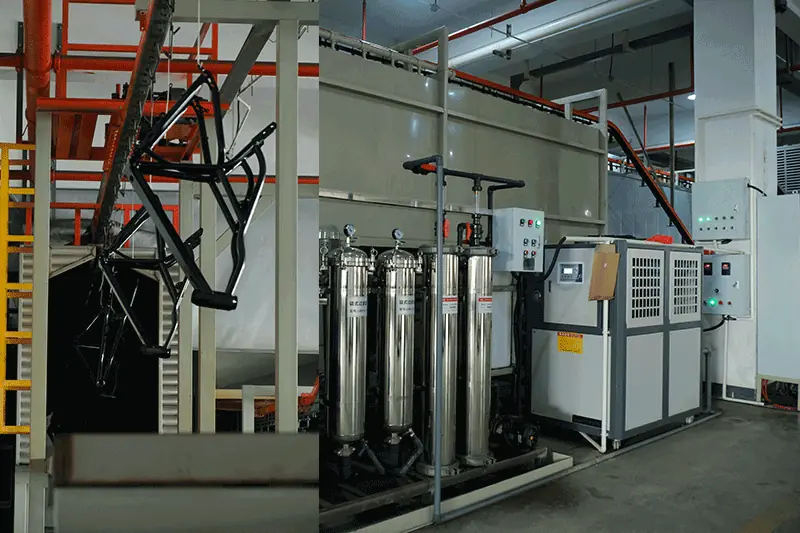
When my B2B clients inspect a frame, their first reaction is often about the surface. They check the color, the finish, and the feel of the paint. But from my perspective as a manufacturer, I'm looking at something different. I’m thinking about whether that frame will survive sea freight, long-term storage, and years of use in rainy or humid weather. The final paint job is what the customer sees, but the process underneath is what guarantees quality. Let's explore why this hidden step is so important.
Is Focusing Only on the Surface Paint a Risk for Your Brand?
A flawless paint job looks great in the showroom. But what happens when a customer complains about rust bubbling up near a weld after just one season of use?
Yes, focusing only on paint is a huge risk. Corrosion rarely starts on flat, open surfaces. It begins in hidden gaps, weld seams, and mounting holes where moisture gathers. Without a proper base coat like e-coating, you're exposing your brand to future warranty claims and damage.
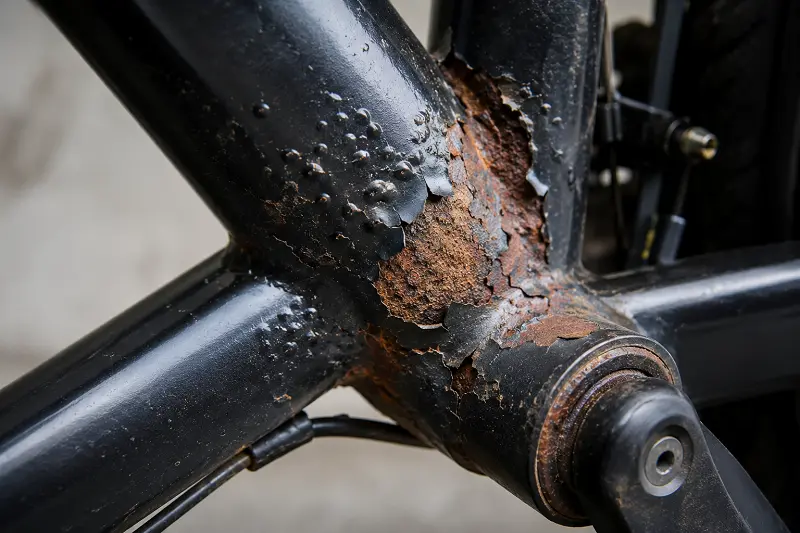
In my years of manufacturing, I've noticed a consistent gap in perspective between clients and producers. It's understandable. Your job is to sell a beautiful, functional product. My job is to make sure that product lasts. These two goals are connected by a process that often goes unseen.
A Tale of Two Perspectives
When an OEM partner looks at a frame, the focus is often on immediate visual appeal. When I look at the same frame, I'm thinking about its entire lifecycle. I imagine it packed in a container, crossing an ocean with salty air, sitting in a warehouse in a humid climate, and then being ridden through rain and mud. The final powder coat determines the first impression, but the e-coat determines if the frame will still look good after three years.
Where Trouble Starts
The most vulnerable parts of an e-bike frame are not the smooth, straight tubes.1
- Weld Seams: The area where tubes are joined is complex and can trap moisture.
- Battery & Motor Mounts: These have bolt holes and cavities that are prime spots for rust.
- Cable Routing Holes: Small openings can let water in, which then gets trapped inside the frame.
- Folding Mechanisms: The hinges and latches on folding e-bikes have many small, hard-to-protect surfaces.
Without a protective layer that covers these specific areas flawlessly, rust is inevitable. It will eventually bubble up from underneath, ruining that perfect paint job you invested in.
How Does E-Coating Protect These Hard-to-Reach Areas?
You might think a good spray gun can cover any surface. But air pressure and paint droplets can't defy physics, often missing the very spots that need protection the most.
E-coating uses a completely different method. The frame is fully submerged in a liquid bath and an electric current is applied. This draws paint particles to every single metal surface, ensuring a perfectly uniform layer inside and out, something spray painting simply cannot achieve.
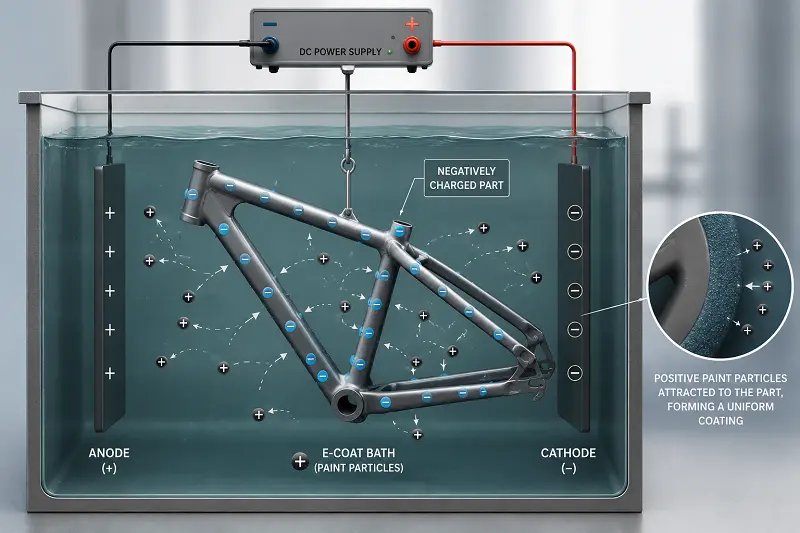
To understand the value of e-coating, it helps to visualize how it works compared to traditional spray priming. It’s not just a better paint; it's a smarter process.
The Science of Total Coverage
Think of it like a magnet. We submerge the e-bike frame, which acts as one electrode, into a tank of water-based paint solution. The paint particles have an opposite electrical charge.2 When we turn on the power, the paint particles are pulled directly to the frame, bonding with the metal. They deposit themselves in an incredibly even layer until the surface is fully insulated, which automatically stops the process. This ensures every corner, every inner tube surface, and every tiny crevice gets the exact same amount of protection.
E-Coating vs. Spray Priming
A simple spray-on primer is fundamentally limited. It’s a line-of-sight application.3
| Feature | Spray-On Primer | Electrophoretic Coating (E-Coating) |
|---|---|---|
| Coverage Method | Atomized paint sprayed onto the surface. | Full immersion with electrical deposition. |
| Hard-to-Reach Areas | Often missed or receive a very thin layer. | Receives a uniform and complete coating. |
| Inner Surfaces | Almost impossible to coat consistently. | Fully coated, preventing internal rust. |
| Corrosion Resistance | Moderate. Relies on the skill of the operator. | Excellent. Creates a consistent, durable barrier. |
This is why e-coating is not just a "nice to have." For the complex geometry of a modern e-bike frame, it is the only way to guarantee that the anti-corrosion layer is truly complete.
Why is E-Coating a Smart Investment for Your E-Bike Brand?
Adding a production step sounds like an extra cost. But what is the real cost of a container of bikes arriving with hidden rust, or handling warranty claims for corrosion?
E-coating is an investment in risk management.4 For brands that export, it ensures products withstand long journeys and arrive in perfect condition. It reduces future warranty costs, protects your brand's reputation for quality, and is essential for products sold in rainy or coastal markets.

I often tell my OEM/ODM partners: don't think of e-coating as a feature for the end-user. Think of it as insurance for your business. The value is realized long before your customer ever rides the bike.
The True Cost of Corrosion
Let's trace the journey. A frame without proper e-coating might look fine leaving my factory. But then it sits in a container for six weeks, exposed to salty sea air. Then it might go into a warehouse in a location with high humidity. By the time it reaches the retail floor, microscopic corrosion may have already begun in the welds and crevices. A year later, that corrosion becomes a visible problem, and a customer service headache for you. The cost of shipping a replacement frame or handling a warranty claim far exceeds the initial cost of e-coating.5
Protecting Your Brand and Your Bottom Line
For any brand, but especially for those building a reputation in a new market, quality and reliability are everything. Here is how e-coating protects your investment:
| Risk Without E-Coating | Benefit With E-Coating |
|---|---|
| Potential for rust during shipping/storage. | Product arrives in pristine, factory condition. |
| High rates of customer complaints in wet climates. | Increased customer satisfaction and brand loyalty. |
| Costly warranty claims and reverse logistics. | Drastically reduced rate of corrosion-related defects. |
| Damage to brand reputation for quality. | Builds a reputation for durability and longevity. |
Ultimately, if your target market is anywhere that experiences rain, humidity, or is near the coast, e-coating stops being an option. It becomes a fundamental part of your quality assurance strategy.6 It's the difference between building a product that looks good and building a brand that lasts.
Conclusion
E-coating is the invisible shield for your e-bike frames. It protects against hidden rust, secures your brand's reputation for quality, and ensures your long-term business success.
"[PDF] A Policy Guide to Steel Moment-Frame Construction", https://www.nehrp.gov/pdf/fema354.pdf. This source identifies weld seams, mounting holes, and other complex areas as the most vulnerable parts of metal frames to corrosion. Evidence role: mechanism; source type: research. Supports: The most vulnerable parts of an e-bike frame are areas like weld seams and mounting holes, not smooth tubes.. Scope note: The vulnerability may depend on the specific design and material of the frame. ↩
"Electrophoretic deposition - Wikipedia", https://en.wikipedia.org/wiki/Electrophoretic_deposition. This source explains the role of electrical charges in attracting paint particles to metal surfaces during the e-coating process. Evidence role: mechanism; source type: education. Supports: Paint particles in e-coating have an opposite electrical charge to the metal surface.. ↩
"Line of Sight - Brigham Young University-Idaho ART 110", https://courses.byui.edu/art110_new/art110/week01/lineofsight.html. This source compares spray-on primers and e-coating, highlighting the limitations of line-of-sight application in spray methods. Evidence role: general_support; source type: research. Supports: Spray-on primers are limited by their line-of-sight application method.. ↩
"Risk Riding Behaviors of Urban E-Bikes: A Literature Review - PMC", https://pmc.ncbi.nlm.nih.gov/articles/PMC6651001/. This source discusses how e-coating reduces risks such as corrosion during shipping and storage, making it a strategic investment for manufacturers. Evidence role: general_support; source type: institution. Supports: E-coating is a strategic investment in risk management for manufacturers.. ↩
"The Differences Between e-Coating vs. Powder Coating", https://gat-systems.com/the-differences-between-e-coating-vs-powder-coating/. This source provides an analysis of the financial implications of warranty claims and replacement costs compared to the cost of e-coating. Evidence role: statistic; source type: institution. Supports: The cost of warranty claims and replacements exceeds the cost of e-coating.. Scope note: The exact cost comparison may vary by manufacturer and market. ↩
"Electrocoating E Coat - Powder Cote II", https://pciicorp.com/electrocoating-e-coat/. This source discusses how e-coating is integral to quality assurance in manufacturing, particularly for corrosion resistance. Evidence role: general_support; source type: institution. Supports: E-coating is a fundamental part of quality assurance strategies in manufacturing.. Scope note: The relevance may vary depending on the product type and market conditions. ↩