Struggling to choose an e-bike that feels safe and stable? You might be focusing on looks, but the real secret to a confident ride is hidden in the frame's design. A poor design can make an e-bike feel wobbly and hard to control.
Frame geometry is the core design that dictates an e-bike's stability and handling.1 Key factors like wheelbase, head tube angle, and battery position determine how the bike feels, not just how it looks. Getting this right is crucial for a safe and confident ride.
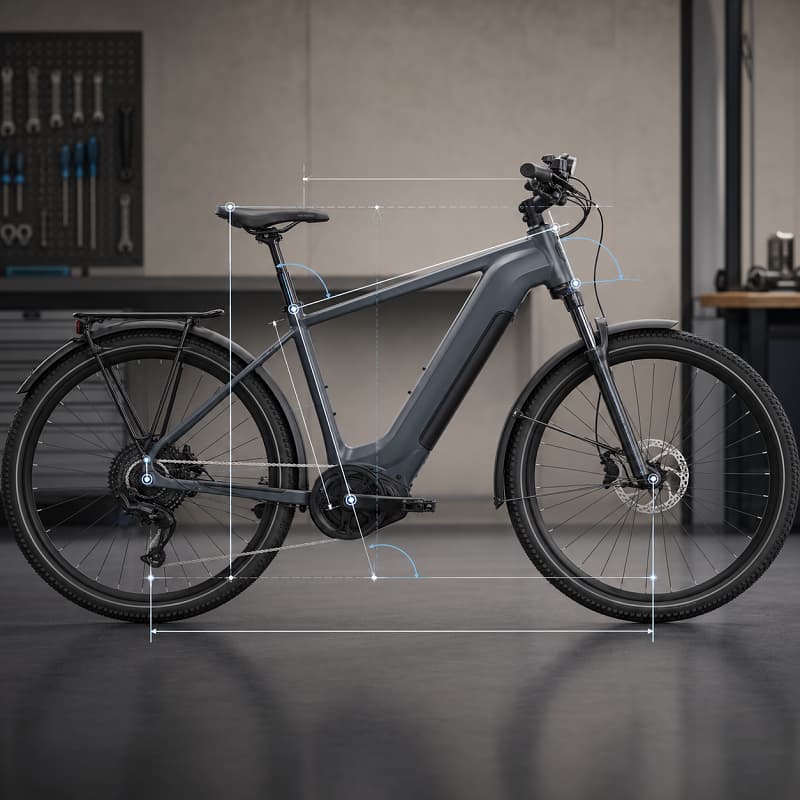
Many of our OEM/ODM clients first notice the style, the color, or whether the battery is integrated. But I always guide them to look at the geometry chart. I've seen two e-bikes with the exact same motor and battery perform completely differently. One feels solid and secure, while the other feels nervous and unpredictable. This difference almost always comes down to the frame's geometry. It’s about creating a bike that gives the rider a feeling of safety. Let's dive into what these numbers really mean.
What Are the Key Geometric Factors for E-Bike Stability?
You see spec sheets with terms like "wheelbase" and "head tube angle," but they just look like numbers. Ignoring these numbers can lead you to approve a design that feels unstable, resulting in poor customer reviews. Let's look at what these critical measurements mean for ride quality.
The key factors are wheelbase, head tube angle, battery position, and chainstay length. A longer wheelbase adds stability, while the head tube angle affects steering responsiveness.2 A low battery position is crucial for a low center of gravity, ensuring better control and balance for the rider.3
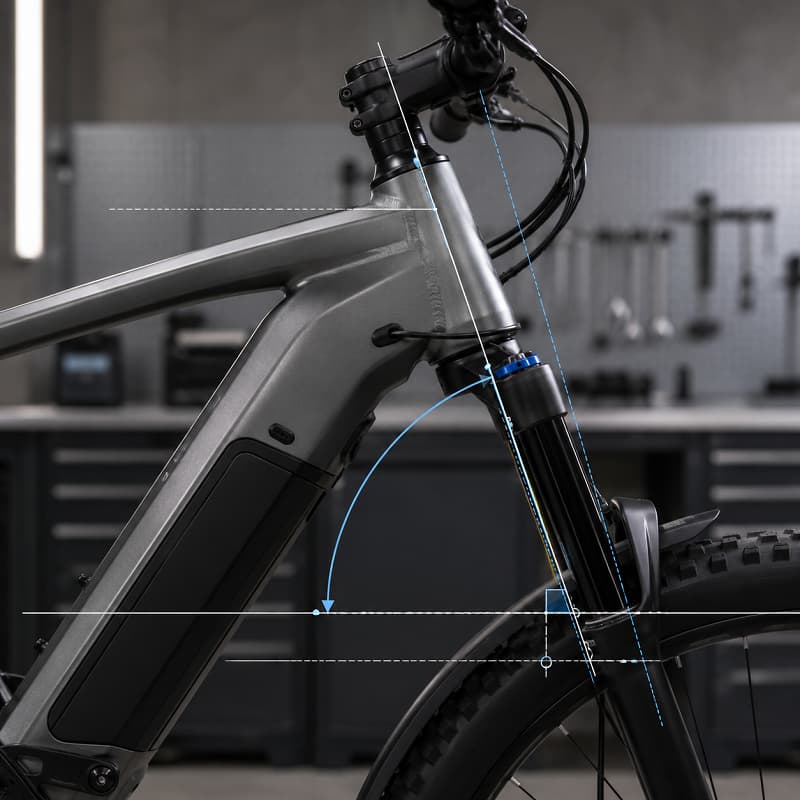
When we design a frame, we are essentially creating a formula for how the bike will behave. An e-bike is heavier than a standard bicycle and has extra components like the motor, battery, and controller. If the geometry isn't right, the bike can feel top-heavy, the steering can feel vague, or it might feel unstable at high speeds. For my B2B clients, understanding these factors is the first step to developing a successful product line. It’s not just about theory; it’s about the real-world feeling your customer will have. Here’s a simple breakdown of the most important factors we consider:
| Geometric Factor | What It Is | Impact on Stability & Handling |
|---|---|---|
| Wheelbase | The distance between the centers of the front and rear wheels. | A longer wheelbase increases stability, especially at high speeds. A shorter wheelbase makes the bike more agile and quicker to turn. |
| Head Tube Angle | The angle of the fork's steering tube relative to the ground. | A slacker angle (e.g., 67°) improves high-speed stability. A steeper angle (e.g., 70°) makes steering quicker and more responsive. |
| Battery Position | Where the battery is mounted on the frame. | A low and central position lowers the center of gravity, making the bike feel much more stable and easier to control, especially at low speeds. |
| Chainstay Length | The distance from the center of the crank to the center of the rear wheel. | Longer chainstays add to stability, which is great for cargo or touring. Shorter chainstays make the bike feel quicker to accelerate. |
Why Does Geometry Matter More for Certain E-Bike Types?
You might think a standard frame geometry works for all e-bikes. But applying a one-size-fits-all approach to models like cargo bikes or fat tire bikes leads to poor performance. A cargo bike could become unstable when loaded, or a folding bike could feel flimsy. Let's explore why these specialized e-bikes need their own unique geometry.
Specialized e-bikes like cargo, fat tire, and folding models have unique demands.4 Cargo bikes must handle heavy loads, fat tire bikes need to manage wide tires and extra weight, and folding bikes must balance compactness with ride stability. Standard geometry simply won't work for them.
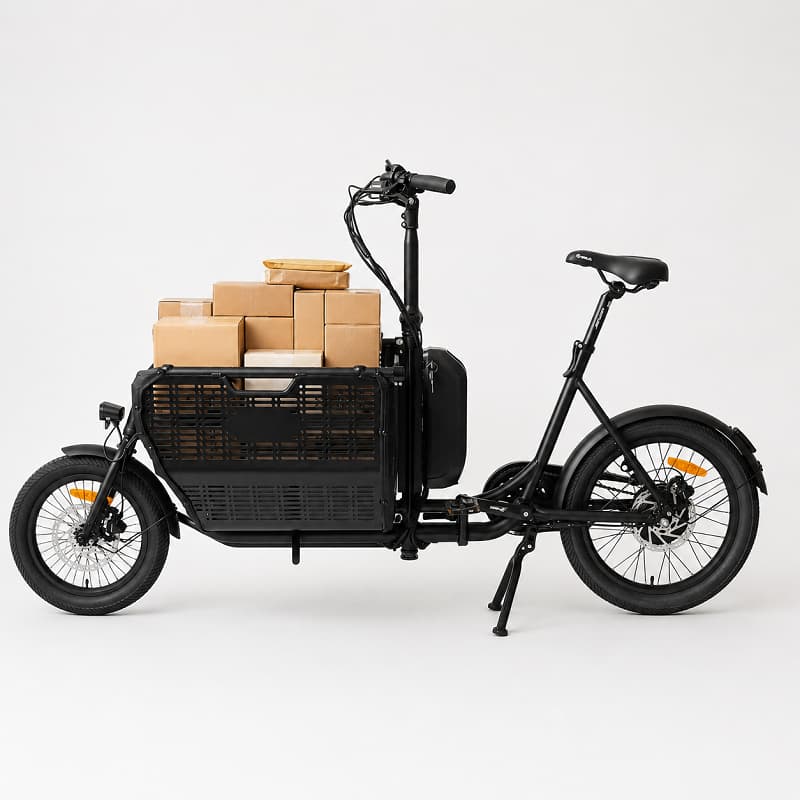
In our factory, we don't just copy and paste designs. Every type of e-bike serves a different purpose, and its geometry must reflect that. For OEM/ODM projects, this is where we add the most value. We think about the end-user and how they will ride the bike. Will they be carrying groceries, riding on sand, or taking the bike on a train? The answer changes everything about the frame's design. It's not just about making the frame strong enough; it's about making it smart enough to handle its specific job.
Cargo E-Bikes
For cargo e-bikes, stability under load is everything. The geometry must be designed to maintain a low center of gravity even with 50kg of goods. This usually means a much longer wheelbase and a frame that positions the cargo area as low as possible. We also consider how the weight will affect steering. A poorly designed cargo bike can become very difficult to turn when loaded, which is a safety risk.5
Fat Tire E-Bikes
The big, heavy tires on these bikes create a strong gyroscopic effect, which makes them want to stay upright.6 However, this can also make low-speed steering feel slow and heavy. We often use a slacker head tube angle to add stability and prevent the steering from feeling strange. The frame also needs massive clearance for the tires, which influences the entire rear triangle and bottom bracket design.
Folding E-Bikes
Here, the main challenge is balancing a compact, portable size with a stable ride. A short wheelbase is necessary for folding, but it can make the ride feel twitchy.7 Our job is to maximize the wheelbase when the bike is unfolded and use a smart head tube angle to create a feeling of stability. The frame's locking mechanisms are also critical; they must be incredibly stiff to make the bike feel like one solid piece.8
Conclusion
In summary, frame geometry is not just an aesthetic choice; it’s the foundation of a safe, stable, and enjoyable ride. It directly defines the user's confidence on the road.
"[PDF] The stability of the bicycle", https://www.phys.lsu.edu/faculty/gonzalez/Teaching/Phys7221/vol59no9p51_56.pdf. This source explains how frame geometry impacts the stability and handling of bicycles, including e-bikes. Evidence role: mechanism; source type: education. Supports: Frame geometry is the core design that dictates an e-bike's stability and handling.. ↩
"[PDF] A bicycle can be self-stable without gyroscopic or caster effects", http://ruina.tam.cornell.edu/research/topics/bicycle_mechanics/stablebicycle/1201959SOMtext.pdf. This source provides an explanation of how wheelbase and head tube angle influence bicycle stability and steering responsiveness. Evidence role: mechanism; source type: education. Supports: A longer wheelbase adds stability, while the head tube angle affects steering responsiveness.. ↩
"[PDF] The Transition To Electric Bikes In China: History And Key Reasons ...", https://itspubs.ucdavis.edu/download_pdf.php?id=1045. This source discusses how battery placement affects the center of gravity and rider control in e-bikes. Evidence role: mechanism; source type: research. Supports: A low battery position is crucial for a low center of gravity, ensuring better control and balance for the rider.. ↩
"[PDF] Regulations of E-Bikes in North America - Portland State University", https://ppms.trec.pdx.edu/media/project_files/NITC-RR-564_Regulations_of_E-Bikes_in_North_America_1.pdf. This source outlines the specific geometric requirements for different types of e-bikes, such as cargo, fat tire, and folding models. Evidence role: definition; source type: encyclopedia. Supports: Specialized e-bikes like cargo, fat tire, and folding models have unique demands.. ↩
"Measuring delivery route cost trade-offs between electric-assist ...", https://depts.washington.edu/sctlctr/sites/default/files/research_pub_files/MeasuringDeliveryRouteCostTrad-Sheth.pdf. This source highlights how improper cargo bike geometry can lead to handling issues under load, posing safety risks. Evidence role: mechanism; source type: research. Supports: A poorly designed cargo bike can become very difficult to turn when loaded, which is a safety risk.. ↩
"The Bicycle Wheel as a Gyroscope - HyperPhysics", http://hyperphysics.phy-astr.gsu.edu/hbase/Mechanics/bicycle.html. This source explains the gyroscopic effect of large tires and its impact on bike stability. Evidence role: mechanism; source type: education. Supports: The big, heavy tires on these bikes create a strong gyroscopic effect, which makes them want to stay upright.. ↩
"[PDF] A bicycle can be self-stable without gyroscopic or caster effects", http://ruina.tam.cornell.edu/research/topics/bicycle_mechanics/stablebicycle/StableBicyclev34Revised.pdf. This source discusses how a short wheelbase affects the ride quality of folding bikes. Evidence role: mechanism; source type: education. Supports: A short wheelbase is necessary for folding, but it can make the ride feel twitchy.. ↩
"Figure 9 - from The design of a composite folding bike to", https://www.academia.edu/figures/14619197/figure-10-second-main-feature-is-the-simplicity-and-speed-of. This source explains the importance of stiff locking mechanisms in folding bike frames for stability. Evidence role: mechanism; source type: research. Supports: The frame's locking mechanisms are also critical; they must be incredibly stiff to make the bike feel like one solid piece.. ↩