Your customers are frustrated, and your support team is overwhelmed. Vague complaints are piling up, but finding the real problem feels like guesswork. Sound familiar? This is a common after-sales nightmare.
An e-bike display's error code function is the single most important tool for reducing after-sales communication costs.1 It allows your team to quickly diagnose issues from afar, turning vague customer complaints into specific, actionable information and dramatically improving efficiency for your B2B business.

Over my 20+ years in e-bike manufacturing, I've seen many clients focus on flashy features while overlooking the fundamentals. They want a bigger screen or a sleeker design, but they don't always appreciate the hidden value of a solid diagnostic system. A well-implemented error code feature isn't just a "nice-to-have" add-on; it's the backbone of an efficient after-sales service department. It saves time, money, and, most importantly, your brand's reputation. Let's dive into why this seemingly small feature has such a massive impact.
How Do Vague Customer Complaints Waste Your After-Sales Resources?
A customer calls your dealer, frustrated. "My new e-bike just stopped working!"2 This simple complaint kicks off a costly and time-consuming process of elimination, draining your resources and patience.
When a customer can only describe a problem vaguely, your support team is forced to play detective. Without an error code, they waste precious time and money shipping parts back and forth, trying to guess the root cause of the failure. This inefficiency directly hurts your bottom line.3

I remember working with a new e-commerce brand in Germany. They launched a city e-bike model that we helped them produce. The bike was beautiful, and initial sales were strong. But within three months, their support lines were flooded. Customers reported issues like "the power cuts out sometimes" or "the display is on, but there's no pedal assist." Their technicians had no clear starting point. Was it the battery? The controller? A loose wire? They started by sending out new batteries, which is one of the most expensive components. Often, that didn't fix the issue. The process was a nightmare. Customers got angry, left bad reviews, and the brand's reputation suffered.4 This experience taught us a valuable lesson: the diagnostic process must be as simple as possible. An error code provides that simplicity. It turns a vague complaint into a clear starting point.
| Diagnostic Process | Without Error Codes (Guesswork) | With Error Codes (Targeted) |
|---|---|---|
| Initial Report | "My bike won't go." | "My bike won't go, and it shows Error 21." |
| First Step | Ask the customer to describe the issue in more detail, maybe shoot a video. | Technician looks up Error 21 in the manual. |
| Diagnosis | Guess the problem could be the battery, controller, or motor. | Manual says Error 21 is a motor Hall sensor fault. |
| Action | Ship a new battery (expensive). If that fails, ship a new controller. | Instruct the customer or dealer to check the motor connection or send a replacement motor Hall sensor. |
| Resolution Time | 1-3 weeks, multiple shipments. | 1-2 days, single shipment. |
| Customer Mood | Frustrated, impatient. | Relieved, impressed with efficiency. |
Is a Bike Without Error Codes Really Simpler to Manage?
Some buyers believe that a bike without error codes is simpler.5 They think it means fewer things can go wrong or that the bike is more "user-friendly." This is a dangerous misconception.
An e-bike without error codes doesn't have fewer faults; its faults are just much harder to find. This creates a massive hidden cost in after-sales service, leading to frustrated dealers, unhappy end-users, and a damaged brand reputation. The initial saving is quickly lost.6

In the OEM/ODM world, every decision is about balancing cost and value. A B2B client might look at two display options. One is a basic LED indicator, and the other is an LCD with a diagnostic system. The basic one is cheaper, so they might choose it to lower the bike's final price. They think they are saving money. But what they are really doing is shifting that cost to their after-sales department, where it will be multiplied tenfold. After they sell a thousand bikes, even a 1% failure rate means ten bikes with problems. If each problem takes hours of back-and-forth emails, videos, and test-swapping parts, the labor costs alone will be huge. Add the cost of shipping replacement parts that weren't even broken, and you see how the initial "saving" disappears. A bike that is difficult to service is not a good product, no matter how low its initial cost is.
Here are the hidden costs of not having an error code system:
- Increased Labor Costs: Your support staff and technicians spend more time on each case, diagnosing instead of fixing.
- Higher Parts Costs: You end up sending out expensive components like batteries or controllers as a "best guess," when the real issue might have been a cheap, simple sensor.
- Wasted Shipping Fees: Shipping parts back and forth, especially internationally, adds up quickly.
- Dealer Dissatisfaction: Your distributors and dealers become frustrated when they can't easily service the products you sell them.7 They may choose a competitor for their next order.
- Negative Brand Image: Slow and ineffective customer service leads to bad online reviews and damages the trust customers have in your brand.
What Makes an Error Code System Truly Valuable for an OEM Project?
Simply having error codes is not enough.8 A poorly designed system can be just as bad as having none at all. It can misdiagnose problems and send your technicians down the wrong path.
A truly valuable error code system is accurate, clear, and well-documented. The codes must reliably point to the correct problem area, and the service manual must explain them in a way that any technician can easily understand and act upon.
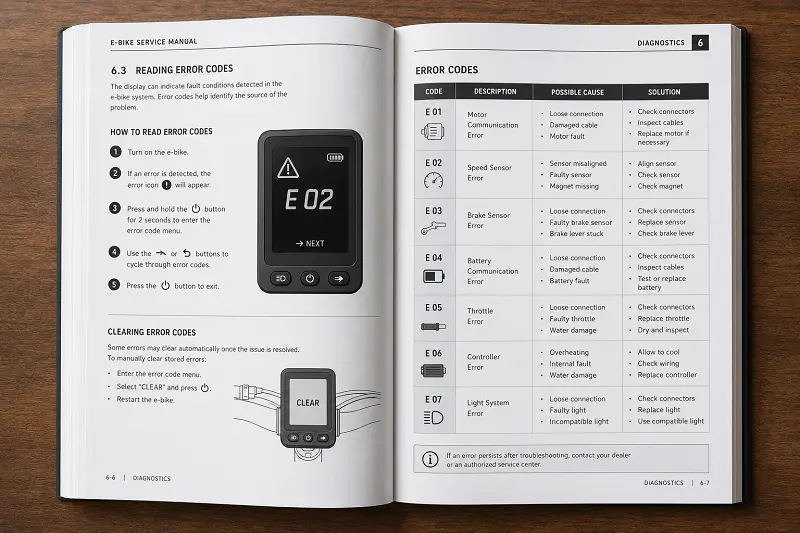
The goal of an error code system is to make after-sales service efficient, not to make the display look more advanced. For our OEM partners, we focus on the practical value. The most important thing is stability and accuracy across the entire electrical system—the display, the controller, and the motor must speak the same language. If the motor's Hall sensor fails, the controller must recognize it and send the correct, specific error code to the display. If that chain is broken, the system is useless. We spend a lot of time ensuring this integration is seamless. We also create clear documentation. The manual we provide to our clients' dealers has a simple chart: "If you see this code, check this component." This transforms after-sales from "guessing the problem" into "locating the problem." It empowers dealers to make quick decisions: check a wire, replace a small part, or schedule a more detailed repair.
| A Good Error Code System | A Bad Error Code System |
|---|---|
| Accurate: Codes correctly identify the fault's source (e.g., brake sensor vs. motor). | Inaccurate: Codes are generic or misleading, causing confusion. |
| Clear: Simple numerical codes (e.g., Error 03) are easy to communicate. | Complex: Vague symbols or overly technical codes that require expert knowledge. |
| Well-Documented: The manual is easy to read, with clear instructions for each code. | Poorly Documented: The manual is missing, poorly translated, or doesn't match the codes. |
| Integrated: The display, controller, and motor firmware are perfectly synced. | Fragmented: Components from different suppliers don't communicate well, causing false errors. |
For any brand selling e-bikes in volume, this invisible efficiency is far more valuable in the long run than a slightly fancier-looking screen.
Conclusion
Investing in a reliable error code system is not an expense; it's an investment in long-term efficiency, customer satisfaction, and the overall health of your brand and its partnerships.
"[PDF] Department of Health and Human Services Centers for Medicare ...", https://www.cms.gov/files/document/csr-recon-error-codesattestaion-error-codes-list-03162016pdf. Error code systems in e-bikes are widely recognized for their role in streamlining diagnostics and reducing communication costs in after-sales service. Evidence role: expert_consensus; source type: research. Supports: Error code systems significantly reduce after-sales communication costs by providing actionable diagnostic information.. Scope note: The importance of error codes may vary depending on the complexity of the e-bike model. ↩
"Most Common eBike Complaints - YouTube", https://www.youtube.com/watch?v=3wOYDoVf2iA. Customer complaints about vague e-bike issues are a common challenge in after-sales service, as documented in industry reports. Evidence role: general_support; source type: institution. Supports: Vague customer complaints are a frequent issue in e-bike after-sales service.. Scope note: Specific examples of customer complaints may vary by region and product type. ↩
"Systematic review and meta‐analysis evaluating the effects electric ...", https://pmc.ncbi.nlm.nih.gov/articles/PMC9546252/. Inefficiencies in diagnosing e-bike issues can lead to increased operational costs, as supported by industry analyses. Evidence role: mechanism; source type: research. Supports: Inefficiencies in diagnosing e-bike issues negatively impact business profitability.. Scope note: The extent of financial impact may depend on the scale of operations and product complexity. ↩
"Analysis of Consumer Behaviour in the Context of the Place ... - PMC", https://pmc.ncbi.nlm.nih.gov/articles/PMC9915062/. Negative customer experiences, such as unresolved e-bike issues, are known to harm brand reputation, as shown in consumer behavior studies. Evidence role: statistic; source type: education. Supports: Unresolved e-bike issues lead to negative reviews and damage brand reputation.. Scope note: The degree of reputational damage may vary based on the severity and frequency of complaints. ↩
"Electric Bike Misconceptions: 10 Common Myths Debunked - Heybike", https://www.heybike.com/blogs/heybike-blog/electric-bike-misconceptions?srsltid=AfmBOorjMLzfgSDKqN4Xw2e6M4DfFaCSKpwr2gDJourAYCAor5B2YjBw. The perception that simpler e-bike designs are more user-friendly is a common misconception, as noted in industry discussions. Evidence role: expert_consensus; source type: encyclopedia. Supports: Some buyers mistakenly believe that e-bikes without error codes are simpler to manage.. Scope note: The misconception may not apply universally across all consumer demographics. ↩
"Failure Modes and Effects Analysis", https://arxiv.org/html/2509.15893v1. Cost analyses in the e-bike industry show that initial savings from simpler designs often lead to higher after-sales expenses. Evidence role: mechanism; source type: research. Supports: Initial savings from simpler e-bike designs often result in higher after-sales costs.. Scope note: The financial impact may vary depending on the scale of operations and product complexity. ↩
"Bike customer service issues with local dealer - Facebook", https://www.facebook.com/groups/4346764052074707/posts/9073926232691775/. Dealer frustration due to service difficulties is a documented issue in the e-bike industry, affecting long-term partnerships. Evidence role: general_support; source type: institution. Supports: Difficulty in servicing e-bikes leads to dealer frustration and impacts partnerships.. Scope note: The extent of frustration may depend on dealer experience and product complexity. ↩
"Electric Bicycles - Regulations.gov", https://www.regulations.gov/document/CPSC-2024-0008-0001. Effective error code systems require accuracy and integration, as highlighted in technical standards for e-bike diagnostics. Evidence role: definition; source type: institution. Supports: Error code systems must be accurate and integrated to be effective in e-bike diagnostics.. Scope note: The effectiveness of error codes may depend on the quality of implementation. ↩