Worried your e-bike displays will fail after a downpour? A high IP rating isn't enough, as hidden issues can lead to costly after-sales problems and damage your brand's reputation.1
To judge an e-bike display's waterproofing, look beyond the IP rating. Focus on practical details like button placement, bezel sealing, and whether the wiring connectors are truly waterproof.2 These factors determine real-world reliability and prevent water from getting in and causing damage.
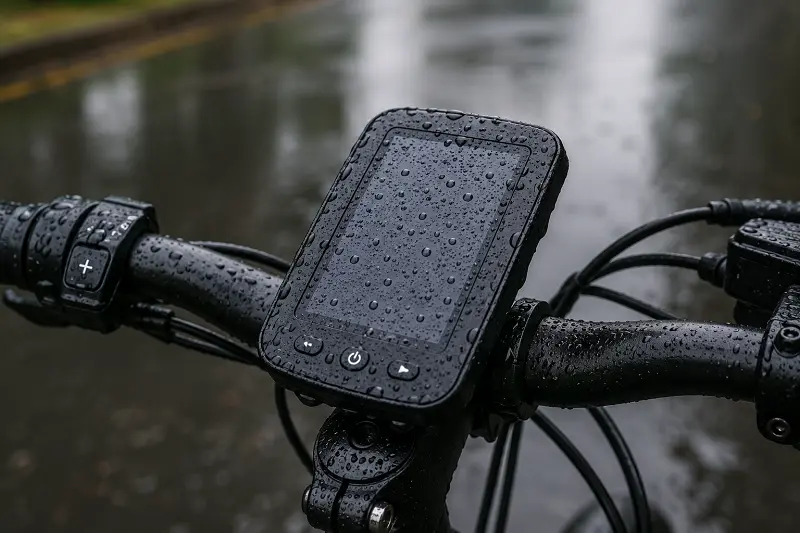
I've seen too many B2B clients fixate on a single number: the IP rating. While it's a starting point, it doesn't tell the whole story. The real proof is in the design, and a faulty display can ruin a customer's entire experience. The problems often don't appear during the sample stage but emerge after your products are out in the market, causing headaches for everyone. So, let's break down what you should really be looking for to avoid these pitfalls.
How Can You Tell if the Display Body is Properly Sealed?
Your display's shell looks solid, but is it truly sealed against the elements? Small gaps in the wrong places can let water in, leading to frustrating and expensive electronic failures.
Check the physical construction. Pay close attention to the seal around the screen bezel, the gaps around the buttons, and where the cable exits the housing. A reliable seal is tight, consistent, and designed to prevent water from pooling or seeping through these vulnerable points.
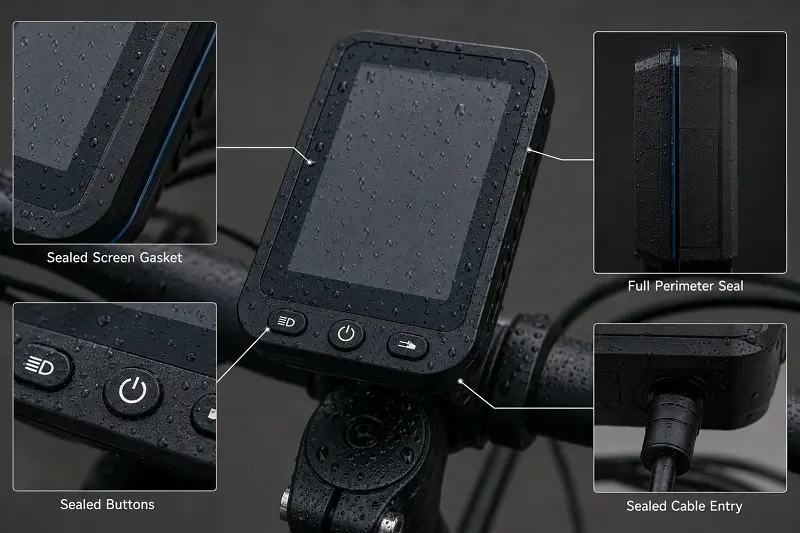
When I evaluate a display, I look at it like a detective looking for clues. The most obvious failures don't come from the flat screen surface but from the tiny gaps and seams. I remember a project where the display had a great IP rating on paper. However, the control buttons were recessed in a small cup-like design. This design collected water like a tiny bowl. After a few months in a rainy market, we started getting reports of buttons sticking or not working. The water just sat there and eventually seeped in. This is why I focus on the physical design, not just the spec sheet. A display's body must be sealed at every potential entry point to be truly weatherproof.
Here are the key areas to inspect:
| Vulnerable Area | What to Check For | Why It Matters |
|---|---|---|
| Screen Bezel | Is the seal even and compressed properly? | An uneven seal creates a direct entry point for water, especially under pressure from heavy rain or washing. |
| Button Gaps | Are buttons flush or recessed? Is there a rubber membrane seal underneath? | Recessed buttons can trap water, increasing the chance of it seeping in over time.3 A good seal is crucial here. |
| Casing Seams | Are they ultrasonically welded, or just snapped or glued together? | Welded seams create a much stronger and more permanent waterproof barrier than simple adhesives that can degrade. |
| Cable Outlet | Is there a tight rubber grommet where the cable exits the housing? | This is a major weak point. A loose or poorly designed grommet will guide water directly inside the display.4 |
Are the Connectors and Wiring Harnesses Actually Waterproof?
A waterproof display is useless if its connection to the bike isn't secure. Water can travel down cables and into your e-bike's central system, causing widespread electronic chaos.5
Insist on certified waterproof connectors for all display wiring. More importantly, check how the wiring is routed on the bike. The connector should never face upwards, and a "drip loop" in the cable is essential to guide water away from the connection point.
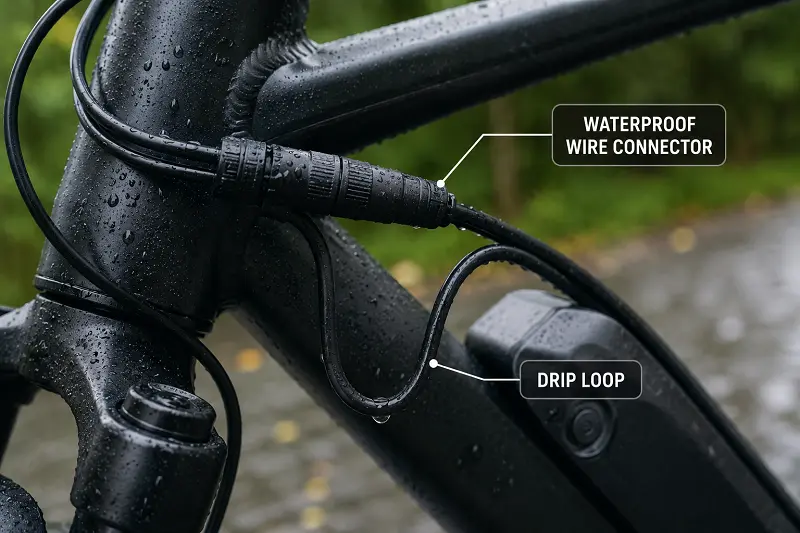
This is a lesson I learned the hard way. We once had a large batch of bikes returned with what customers called "faulty displays." When we got them back to our facility for testing, the displays themselves were perfectly fine. The real issue was the assembly. The factory had routed the display cable directly into an upward-facing connector on the frame. This created a small cup that collected every drop of rain. The water ran straight down the cable and flooded the connection, causing a short. The end-user sees a dead display and blames the component, but the root cause was a simple, preventable wiring mistake. This taught me that display waterproofing is a whole-bike issue, not just a component-level one. A good manufacturer considers the entire system.
Here’s how to ensure the connections are as waterproof as the display itself:
| Wiring Element | Good Practice | Bad Practice (A Red Flag) |
|---|---|---|
| Connector Type | Uses multi-pin waterproof connectors with internal rubber seals. | Uses simple pin headers or non-sealed plugs that offer no protection. |
| Connector Orientation | Connectors face downwards or sideways to let water run off. | Connectors face upwards, creating a "bowl" that collects water and debris. |
| Cable Routing | Includes a "drip loop"—a U-bend in the cable before the connector. | A straight, taut cable running directly into the connector, guiding water in. |
| Cable Protection | The harness is shielded or neatly tucked within the frame or sheathing. | The cable is exposed and can rub against the frame, potentially wearing down the insulation. |
Is the Display Suitable for Your Target Market's Environment?
Choosing a one-size-fits-all display can be a costly mistake. A component that works perfectly in a dry climate might fail miserably in a humid, rainy, or coastal region.
You must match the display's waterproofing level to your target market. For rainy or coastal areas with salty air, you need superior sealing, corrosion-resistant materials, and a robust wiring design. This means going beyond basic standards to ensure long-term durability.
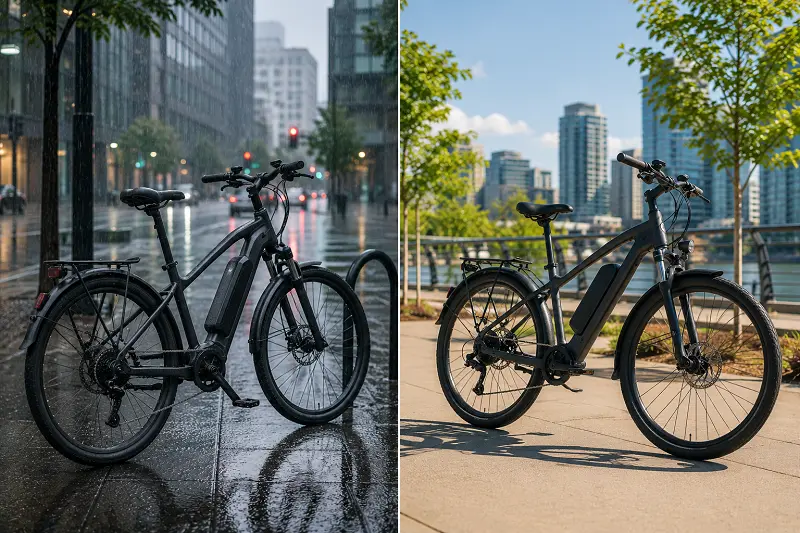
As an OEM/ODM partner, one of the first questions I ask a new client is, "Where will these bikes be sold and used?" The answer changes everything. If you're selling bikes in Arizona, our standard high-quality display will perform great for years. But if you tell me you're targeting the market in the UK or the Netherlands, I will immediately recommend a different set of components and design considerations. In those constantly damp environments, even the smallest design flaw will eventually lead to failure. The same goes for coastal markets like Florida, where salty air is a killer for electronics. The salt accelerates corrosion on any exposed metal, so we need to use corrosion-resistant connectors and ensure the sealing is absolutely perfect. Thinking about the end environment isn't an upsell; it's a critical part of building a reliable product that won't come back to haunt you with warranty claims.
Consider these environmental factors:
| Market Type | Key Challenge | Recommended Solution |
|---|---|---|
| Rainy (e.g., London, Seattle) | Frequent, prolonged water exposure. | Highest IP rating, robust body seals, and mandatory drip loops in the wiring. |
| Coastal (e.g., Miami, Sydney) | Salt spray and high humidity. | Corrosion-resistant connectors (gold-plated pins), conformal coating on internal PCBs, and perfect sealing. |
| Hot & Sunny (e.g., Dubai, Phoenix) | UV degradation and extreme heat. | UV-stabilized plastics for the housing and seals to prevent them from becoming brittle, plus heat-resistant electronics. |
| Shared Fleet (e.g., City Bike Share) | Constant exposure to all elements. | The most robust design possible, combining all the above solutions for maximum durability and field serviceability. |
Conclusion
Effective display waterproofing isn't about an IP rating.6 It's about thoughtful design and system integration that prevents real-world failures, protecting your investment and your brand's reputation.
"Consumers blame both manufacturer and retailer when products fail ...", https://mendoza.nd.edu/news/consumers-blame-when-products-fail/. This source discusses how hidden design flaws in electronic components can lead to increased warranty claims and customer dissatisfaction. Evidence role: mechanism; source type: research. Supports: Hidden issues in e-bike displays can result in costly after-sales problems and harm brand reputation.. Scope note: The source may not specifically address e-bike displays but covers general electronic product failures. ↩
"DIY Waterproofing of Electronics", https://www.youtube.com/watch?v=3WtmKr2bwzU. This source explains the importance of physical design elements like button placement and sealing in ensuring waterproofing for electronic devices. Evidence role: mechanism; source type: education. Supports: Button placement, bezel sealing, and waterproof wiring connectors are critical for real-world reliability in e-bike displays.. Scope note: The source may focus on general electronics rather than e-bike displays specifically. ↩
"The Effects of Smart Home Interface Touch Button Design Features ...", https://pmc.ncbi.nlm.nih.gov/articles/PMC8872557/. This source explains how recessed buttons in electronic devices can trap water, leading to long-term reliability issues. Evidence role: mechanism; source type: education. Supports: Recessed buttons in electronic devices can trap water, increasing the risk of seepage and reliability issues.. Scope note: The source may focus on general electronics rather than e-bike displays specifically. ↩
"Waterproof Grommets - WC Car Audio", https://wccaraudio.com/waterproof-grommets/?srsltid=AfmBOordpd8ZY809CENaO0MMOe0tyEbIVm_viSBCJFGbLiFKf-tgEcu8. This source explains how poorly designed grommets can compromise waterproofing in electronic devices by allowing water ingress. Evidence role: mechanism; source type: education. Supports: Loose or poorly designed grommets can allow water ingress into electronic devices, compromising their waterproofing.. Scope note: The source may focus on general electronics rather than e-bike displays specifically. ↩
"Water ingress into potted electronics via the cabling - EEVblog", https://www.eevblog.com/forum/projects/water-ingress-into-potted-electronics-via-the-cabling/. This source discusses how water ingress through cables can lead to widespread electronic failures in systems. Evidence role: mechanism; source type: research. Supports: Water ingress through cables can lead to widespread electronic failures in interconnected systems.. Scope note: The source may not specifically address e-bike systems but covers similar electronic setups. ↩
"IP Ratings Explained | Ingress Protection Rating | IP Codes", https://clarionuk.com/resources/ip-ratings/. This source critiques the limitations of IP ratings in assessing real-world waterproofing effectiveness for electronic devices. Evidence role: expert_consensus; source type: research. Supports: IP ratings alone are insufficient for assessing real-world waterproofing effectiveness in electronic devices.. Scope note: The source may not specifically address e-bike displays but discusses general limitations of IP ratings. ↩