Your customers want a folding e-bike, but you fear the after-sales headaches. The real problem isn't the fold; it's the wobble, the creaks, and the potential safety issues down the line.
A great folding e-bike frame focuses on the strength and reliability of its folding mechanism, not just its folded size. The hinge and latch must be robust to prevent wobbling, noise, and long-term wear1, ensuring the bike feels as solid as a non-folding model for rider safety.
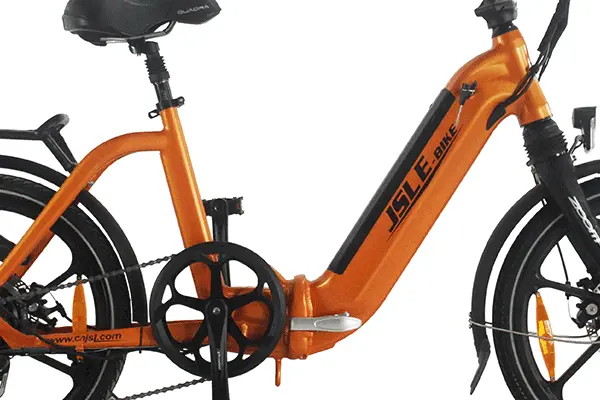
When B2B clients first look at folding e-bikes, their eyes usually go to three things: how small it gets, if it fits in a car trunk, and how sleek it looks. These are important, but as a manufacturer with over 20 years of experience, I’ve learned to look deeper. The real story of a folding bike's quality is hidden in its structure. A flashy fold means nothing if the bike becomes a rattling, unsafe mess after six months of use. For your brand and your customers, long-term reliability is everything. Let's dive into the details that truly matter.
Is the Folding Hinge and Latch Strong Enough for Daily Use?
You’ve seen it: a sample folding bike feels solid at first. But you worry that after hundreds of folds, that secure feeling will turn into a dangerous wobble for your customer.
The folding hinge and latch are the heart of the frame's integrity. A quality design uses high-strength materials and a precision locking system that leaves no room for movement. This ensures the bike feels rigid and safe, protecting your brand from the nightmare of structural failures.
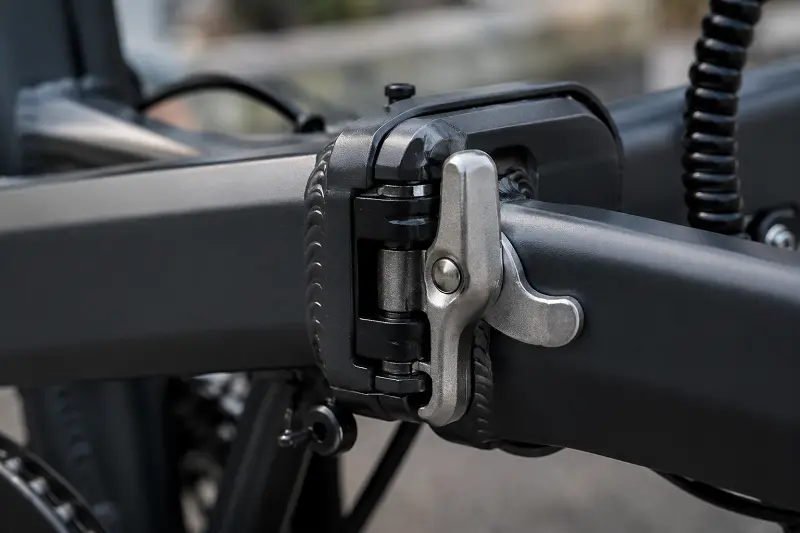
The biggest difference between a standard frame and a folding one is that you intentionally cut the main structural tube in half. That connection point, the hinge, now has to bear all the stress that a solid tube would. If it's not engineered perfectly, it will fail. In the short term, a sample might feel fine. But after daily use, a poorly designed hinge can lead to metal fatigue, a loose latch, and a frame that visibly flexes and creaks during rides. This isn't just annoying; it’s a serious safety concern. For you, the OEM/ODM client, this is the worst kind of after-sales problem. You can't just send a customer a new part. A frame issue often means a full product replacement and a major blow to your brand's reputation for quality.
| Feature | Poor Design (High Risk) | Good Design (Low Risk) |
|---|---|---|
| Hinge Material | Standard cast or welded parts | Forged aluminum or CNC-machined alloy |
| Latch Mechanism | Simple, single-action clamp | Double-locking system with safety catch |
| Frame Feel | Noticeable flex or creaking when locked | Feels completely solid, like a non-folding frame |
| Long-Term Risk | Loosens over time, causes noise and wobble | Maintains tight tolerance after thousands of folds |
Why is Cable Routing More Important Than You Think?
Your customer calls with a frustrating problem: their folding e-bike’s display is flickering or the motor assist cuts out randomly. You suspect a complex electronic issue, but the real culprit is simpler.
In a folding e-bike, cables are constantly bent, stretched, and pulled2. Without smart routing, protected channels, and the right amount of slack, wires will eventually wear out or disconnect. This creates electrical "ghost" problems that are frustrating for customers and difficult for support teams to diagnose.
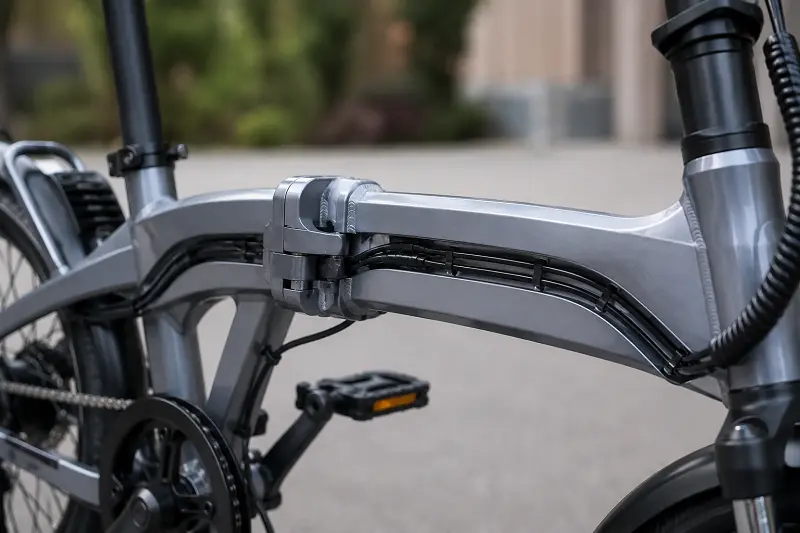
This is one of the most overlooked aspects of folding e-bike design. In a regular e-bike, cables are set in place and rarely move. On a folding bike, the main harness for the motor, battery, and display has to pass through the hinge area. Every time the bike is folded and unfolded, these cables are stressed. If the design doesn't account for this movement, things go wrong. The outer sheath of a cable can get abraded, exposing the wires inside. Connectors can be pulled loose, causing intermittent power loss. We've seen cases where what looks like a faulty controller was actually just a pinched wire inside the folding joint. Fixing it isn't easy3. That’s why we spend so much time designing the internal routing paths, ensuring there’s enough slack, and using protective guides to prevent any damage over the bike's lifetime.
| Problem Area | Common Mistake | Professional Solution |
|---|---|---|
| Hinge Area | Cables are pinched or stretched during folding. | A "service loop" with extra slack is created inside the frame. |
| Cable Protection | Bare cables rubbing against metal frame edges. | Using nylon guides and protective sheaths at all entry/exit points. |
| Connectors | Standard connectors that can pull apart easily. | Using locking, waterproof connectors that are secured in place. |
| Testing | Tested for a few dozen folds. | Robotically tested for thousands of fold/unfold cycles to simulate years of use. |
Does Battery Placement Really Affect Portability and Balance?
You're sourcing a folding bike and see one with a huge battery capacity, which seems like a great selling point. But when folded, the bike is clumsy, heavy, and awkward to carry.
Yes, it absolutely does. The battery is often the heaviest single component on an e-bike. Poor placement can ruin the center of gravity4, making the bike feel unstable to ride and a nightmare to lift or roll when folded. A truly portable design integrates the battery thoughtfully.
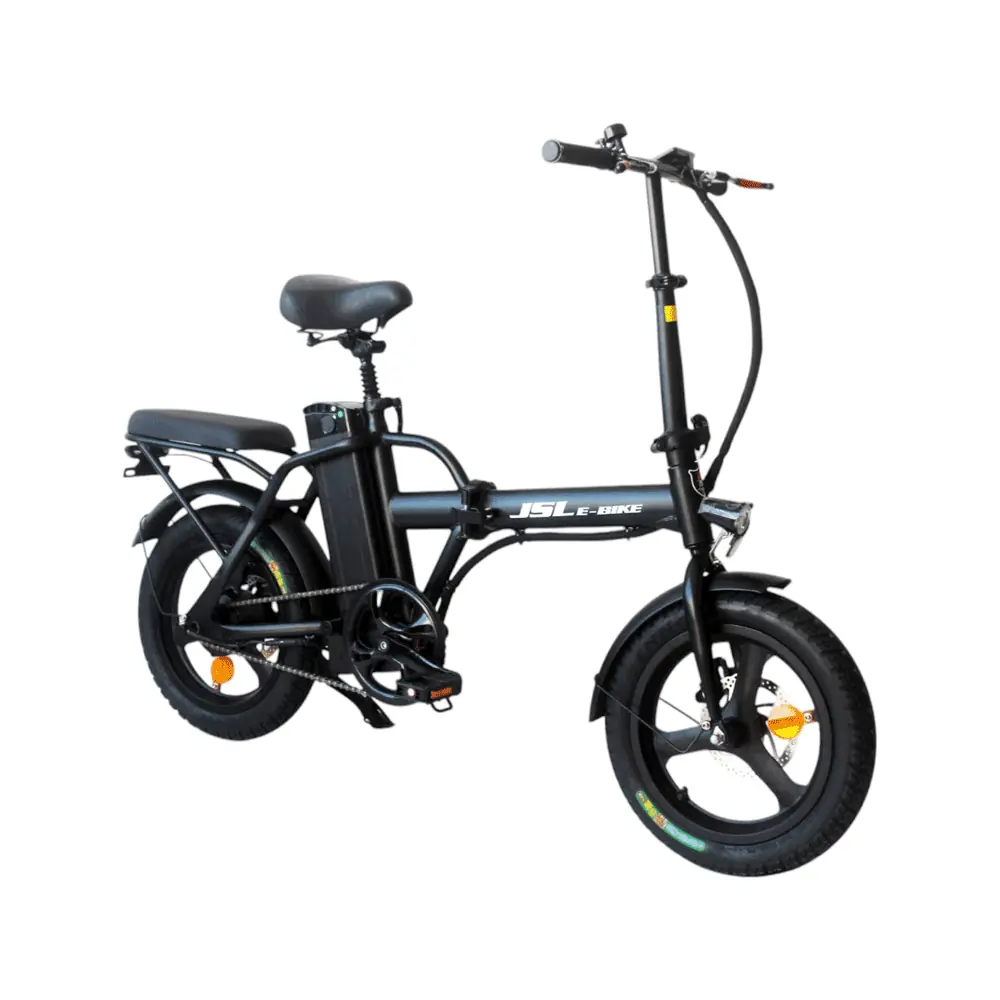
Folding e-bikes are all about convenience. That convenience is destroyed if the bike is too heavy or unbalanced to actually move around once it's folded. Many brands chase bigger battery capacity numbers for marketing5, but they forget about the user experience. If a 15kg bike suddenly has a 4kg battery hanging off the back, it becomes incredibly awkward. When the user tries to lift it into a car, the weight is unevenly distributed and hard to manage. The bike's balance while riding is also affected. A high or rear-heavy center of gravity can make the bike feel twitchy and less stable6, especially for smaller riders. We always consider the complete package. Is the battery removable for easier carrying? Is the weight centered and low to the ground? A bike with a slightly smaller, well-placed battery is often a much better product7 than one with a massive, poorly located battery.
| Battery Position | Pros | Cons |
|---|---|---|
| Seatpost Battery | Centralizes weight; easy to remove; looks clean. | Limits seat height adjustment; can have higher center of gravity. |
| Rear Rack Battery | Allows for a low step-through frame design. | Creates a high, rear-heavy balance; makes the bike hard to carry. |
| Integrated in Frame | Excellent weight distribution; very stable feel. | Makes the bike heavier to lift as one piece; often not removable. |
| Behind Seat Tube | Keeps weight low and centered. | Can interfere with the folding mechanism or make the folded package larger. |
Conclusion
A great folding e-bike isn't just about folding. It's about finding the perfect balance between convenience, riding stability, and long-term durability. Look past the fold for lasting market success8.
"Folding bicycle - Wikipedia", https://en.wikipedia.org/wiki/Folding_bicycle. This source explains the importance of robust hinge and latch mechanisms in folding bikes to ensure stability and durability. Evidence role: mechanism; source type: education. Supports: A great folding e-bike frame focuses on the strength and reliability of its folding mechanism, not just its folded size.. ↩
"Mechanical Properties and Fatigue Life Analysis of Motion Cables in ...", https://pmc.ncbi.nlm.nih.gov/articles/PMC10893113/. This source highlights the challenges of cable wear and tear in folding bikes due to repeated bending and stretching. Evidence role: mechanism; source type: research. Supports: Cables in folding bikes are subject to wear and tear due to constant bending and stretching.. ↩
"New ebike, old parents, anyway to fix this cut cable mistake safely or ...", https://www.reddit.com/r/ebikes/comments/1feqx7c/new_ebike_old_parents_anyway_to_fix_this_cut/. This source discusses the difficulty of diagnosing and repairing cable-related issues in folding e-bikes. Evidence role: general_support; source type: education. Supports: Fixing cable-related issues in folding e-bikes is challenging.. ↩
"Center vs Rear: The Physics Behind Electric Bike Battery Placement", https://leoguarbikes.com/blogs/news/electric-bike-battery-placement?srsltid=AfmBOopHwGkPZwTzGRmdQuSEMTzOLbyV7w7E48OtpK-XPa95LLhNSlku. This source explains how improper battery placement can negatively affect the center of gravity and stability of e-bikes. Evidence role: mechanism; source type: education. Supports: Poor battery placement can ruin the center of gravity in e-bikes.. ↩
"E-Bike Market Size, Share, Scope, Trends, Growth Report 2035", https://www.marketresearchfuture.com/reports/e-bike-market-1876. This source discusses the trend of prioritizing battery capacity for marketing purposes in the e-bike industry. Evidence role: expert_consensus; source type: research. Supports: Many brands prioritize larger battery capacities for marketing purposes.. ↩
"Tech Talk: Centre Of Gravity | The Science Behind eBike Stability", https://www.youtube.com/watch?v=_8W2I-y5m9M. This source explains how a high or rear-heavy center of gravity affects the stability and handling of e-bikes. Evidence role: mechanism; source type: education. Supports: A high or rear-heavy center of gravity can make an e-bike feel twitchy and less stable.. ↩
"Why do all big-name ebikes have such small batteries? - Reddit", https://www.reddit.com/r/ebikes/comments/1h6mbu9/why_do_all_bigname_ebikes_have_such_small/. This source argues that a smaller, well-placed battery can improve the overall usability and balance of an e-bike. Evidence role: expert_consensus; source type: education. Supports: A smaller, well-placed battery often results in a better e-bike product.. ↩
"Systematic review and meta‐analysis evaluating the effects electric ...", https://pmc.ncbi.nlm.nih.gov/articles/PMC9546252/. This source emphasizes the importance of long-term durability and usability over folding convenience in e-bike design. Evidence role: expert_consensus; source type: education. Supports: Long-term durability and usability are more important than folding convenience for market success.. ↩