Are you thinking a cargo e-bike is just a longer version of a regular bike? This common mistake can lead to serious safety issues and costly after-sales problems down the road.
A true cargo e-bike is an entirely new vehicle, not just a stretched frame. The reason is simple: adding significant weight changes the entire vehicle's physics1, affecting its center of gravity, braking, and stability. This requires a purpose-built frame and components designed specifically for safety under load.
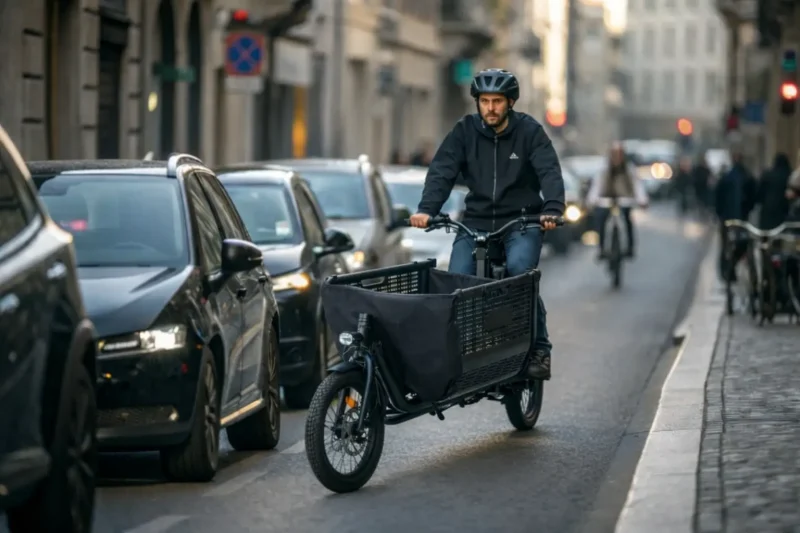
When I first entered the e-bike industry over 20 years ago, the concept was simple: put a motor on a bicycle. But with cargo e-bikes, I quickly learned that this simple approach doesn't work. The entire philosophy has to change. We aren't just making a bigger bicycle; we are engineering a light transport vehicle. The difference is critical, and it’s something I always emphasize to my OEM/ODM clients. Understanding this distinction is the first step to building a successful and safe cargo e-bike line. Let's dive into why simply making a bike longer is a recipe for failure.
What Really Changes When You Add More Weight?
You see a bike with a long rear rack and think it's ready for heavy loads. But once you pile on groceries or put a child on the back, it feels wobbly and unsafe.
Adding significant weight completely shifts a cargo e-bike's center of gravity and multiplies the stress on the frame. This dramatically impacts braking distance, steering control, and structural integrity. A standard frame isn't designed to handle these new dynamic forces safely.
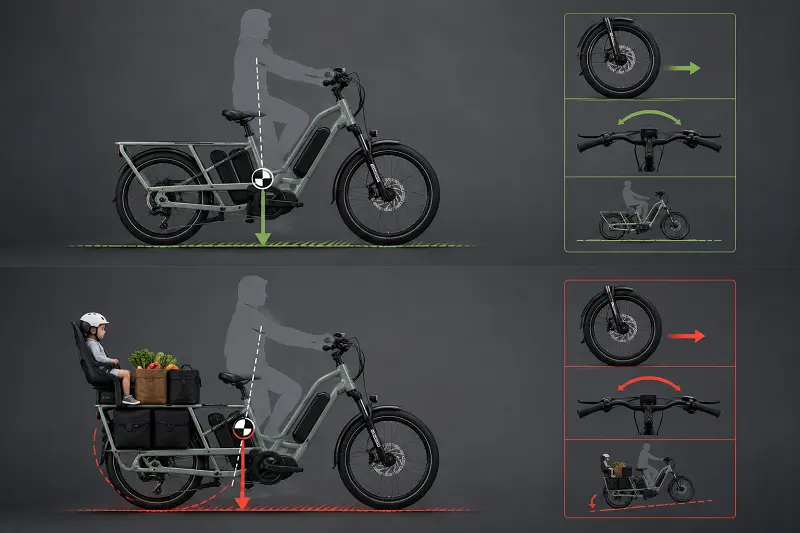
I've seen many samples over the years that look good on paper. They have a long frame and a big rack. The spec sheet says it can carry 100kg. But the real test isn't in the showroom; it's on a steep hill, fully loaded, on a rainy day. This is where the physics of weight and force become very real. A frame that wasn't designed from the ground up for these forces will twist, flex, and eventually fail. The problem is that these failures don't always happen immediately. They appear after months of use, creating a huge risk for the user and a nightmare for your brand's warranty department and reputation.
The Critical Shift in Center of Gravity
On a standard bicycle, the center of gravity is relatively fixed and predictable, centered around the rider. On a cargo e-bike, the load is the variable2. One day it might be two bags of groceries low on the rack; the next, it could be a tall, wiggling child in a seat. This constantly changing and often high center of gravity places immense demands on the bike's stability. If the frame geometry—like the head tube angle and wheelbase3—isn't specifically designed to counteract these forces, the bike will feel "floppy" and uncontrollable, especially in turns. A simple stretched frame retains the geometry of a standard bike, making it dangerously unstable when the real work begins.
The Hidden Stresses on the Frame
A frame that is only lengthened, not re-engineered, is a ticking time bomb. The connection points, like where the rear triangle joins the main frame or where the head tube is welded, become major stress concentrators.
| Feature | Standard E-Bike | Cargo E-Bike |
|---|---|---|
| Primary Load | Rider (approx. 75-90 kg) | Rider + Cargo (up to 200+ kg total) |
| Key Stress Points | Bottom bracket, head tube | Entire frame, especially mid-section and rear stays |
| Core Design Goal | Lightweight and efficient | Strength, stiffness, and durability under load |
Over time, the repeated flexing from heavy loads will cause material fatigue4 in these weak spots. This can lead to microscopic cracks that grow until the frame fails catastrophically. A proper cargo e-bike frame uses thicker tubing, extra gussets for reinforcement, and a completely different structural design to distribute these forces safely across the entire chassis. It's built to withstand the constant punishment of carrying heavy, dynamic loads day in and day out.
Why Do Standard Components Fail on a Cargo E-Bike?
You found a cargo e-bike that seems like a great deal. But after a few heavy trips, the brakes feel weak, the wheels seem to wobble, and you hear strange noises.
Standard e-bike components like brakes, wheels, and motors are not rated for the massive extra weight and stress of a fully loaded cargo e-bike. Using them results in poor performance, accelerated wear, and critical safety risks like brake failure or wheel collapse.
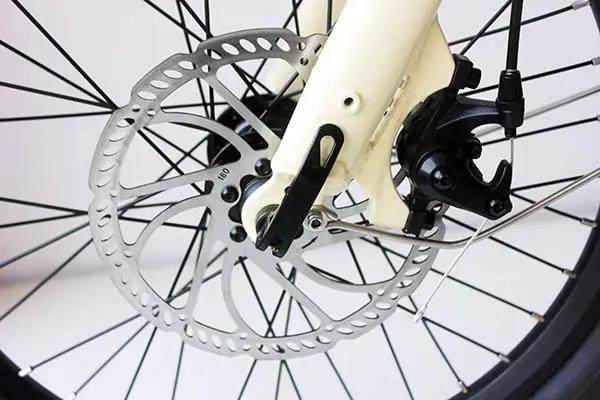
I recall a conversation with a potential client who was comparing our quote with a much cheaper one. The other factory was using standard wheels and mechanical disc brakes on their "cargo" model. I had to explain that while it saves money upfront, it's like putting the brakes from a small car onto a fully loaded truck. They might work a few times, but they will fail when you need them most. The components are not just accessories; they are an integral part of the safety system. On a cargo e-bike, every single component must be chosen and tested with the maximum possible weight in mind.
Braking: More Than Just Stopping Power
The physics are undeniable: a heavier object moving at the same speed has more momentum and requires much more force to stop. A fully loaded cargo e-bike can easily weigh over 200 kg. Standard mechanical or even light-duty hydraulic brakes simply cannot dissipate the heat generated from stopping that much weight, especially on a long downhill. This leads to "brake fade," a terrifying situation where the brakes lose all stopping power5. That's why true cargo e-bikes must use powerful hydraulic disc brakes, often with larger 180mm or 203mm rotors and sometimes even 4-piston calipers, to provide reliable, consistent stopping power in all conditions.
The Unsung Heroes: Wheels, Tires, and Motor
The wheels on a cargo bike are under constant, immense pressure. They support not just the vertical weight but also endure powerful lateral forces during turns. Using standard bicycle wheels is a huge mistake. A proper cargo e-bike requires wheels built with double-walled, heavy-duty rims6; thicker, stronger spokes (like 12-gauge or 13-gauge instead of the standard 14-gauge); and reinforced hub axles that won't bend or break. Likewise, the motor needs to be different. It’s not about top speed, but about low-end torque. The motor must be powerful enough to get a 200kg vehicle moving from a complete stop, especially on a hill, without straining or overheating. This requires a motor specifically tuned for high-torque output at low RPMs7.
How Should a Factory Approach Cargo E-Bike Design?
You're a business looking to source a cargo e-bike. Many factories will show you a long bike and call it a cargo model, hiding the design flaws that will become your problem later.
A professional factory treats a cargo e-bike as a light transport vehicle, not a stretched bicycle. The entire design process must start from the ground up, focusing on a new force-bearing structure, validated stability, and component durability proven through rigorous, load-based testing.
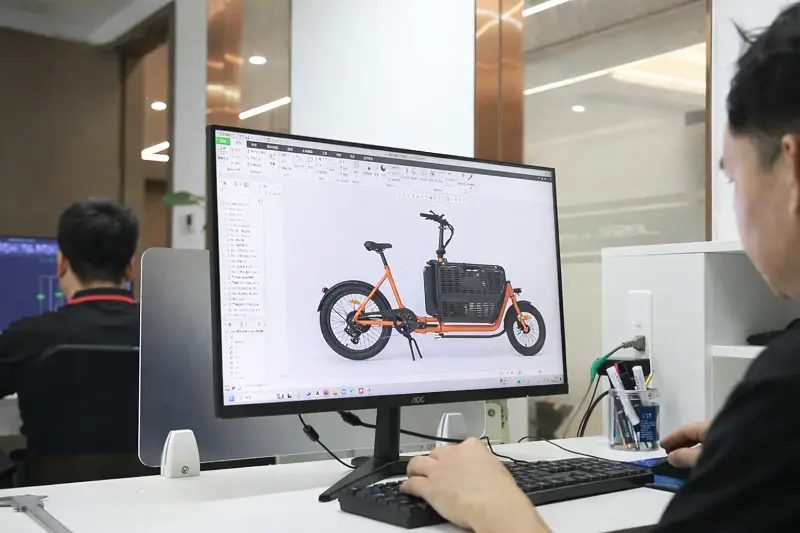
I remember a client who came to us after a terrible experience. Their previous supplier had simply welded an extension into a regular frame to create a "longtail" cargo bike. The samples looked fine, and the price was low. But six months after their customers started using them, the warranty claims flooded in: cracked frames, unstable handling, and brake issues. They learned the hard way that a low price often hides a lack of engineering. Our approach is fundamentally different. We see a cargo e-bike as a tool designed for a tough job, and we build it to be strong, reliable, and, above all, safe for the person who depends on it every day.
From Bicycle to Light Vehicle: A Mindset Shift
The most important step is a change in mindset. We are not just moving a person anymore; we are moving valuable cargo, which could be goods for a business or even precious cargo like children. This means our design priorities must change. We obsess over things like low-speed maneuverability when fully loaded8, ensuring the rider can easily navigate tight spaces. We engineer ultra-strong, dual-leg kickstands9 that can hold the bike steady while loading and unloading. We run fatigue tests on our frames that simulate years of use10 under maximum load. This is the difference between a "bicycle" and a "light transport vehicle." It's a commitment to industrial-grade durability, not just recreational use.
Key Questions for Your OEM/ODM Partner
When you evaluate a potential manufacturing partner, you need to ask questions that go beyond the spec sheet. Their answers will reveal if they truly understand cargo e-bike engineering.
| Question to Ask Your Supplier | Why It's a Critical Question |
|---|---|
| "Did you re-engineer the frame's force structure, or just stretch a standard design?" | This immediately separates true engineers from assemblers. It shows if they understand the fundamental physics of a loaded frame. |
| "What are the detailed specs of the brakes, wheel rims, and spokes?" | This tests if they have upgraded the critical safety components to match the load, or if they are cutting corners with standard parts. |
| "How do you test for stability and durability under the maximum rated load?" | Ask for their testing protocols. A good factory will have frame fatigue tests, loaded brake tests, and real-world road test reports. |
| "What is the motor's rated torque, and how does it perform on a loaded hill start?" | This shows if they have considered real-world performance. A high-wattage motor with low torque is useless on a cargo e-bike. |
Asking these questions will help you identify a partner who builds for safety and reliability, protecting your brand and your customers.
Conclusion
A cargo e-bike is not a stretched bicycle; it is a purpose-built vehicle. Focusing on real engineering over simple looks is the only way to ensure safety, reliability, and long-term success.
"Accelerating and braking - Dynamics", https://dynref.engr.illinois.edu/ava.html. This source explains how additional weight impacts the center of gravity, braking, and stability of vehicles, including bicycles. Evidence role: mechanism; source type: education. Supports: Adding significant weight changes the physics of a vehicle, affecting its center of gravity, braking, and stability.. ↩
"Analyzing the impact of bicycle geometry and cargo loading ... - PMC", https://pmc.ncbi.nlm.nih.gov/articles/PMC11033132/. This source discusses how variable loads affect the center of gravity and stability in bicycles and similar vehicles. Evidence role: mechanism; source type: education. Supports: The load on a cargo e-bike is a variable that significantly affects its center of gravity and stability.. ↩
"Analyzing the impact of bicycle geometry and cargo loading ... - PMC", https://pmc.ncbi.nlm.nih.gov/articles/PMC11033132/. This source discusses how head tube angle and wheelbase affect the stability and handling of bicycles. Evidence role: mechanism; source type: education. Supports: Head tube angle and wheelbase are critical factors in the stability and handling of cargo e-bikes.. ↩
"fatigue strength - Properties of Materials", https://www.ae.msstate.edu/vlsm/materials/fatigue/fatigue.htm. This source explains how material fatigue occurs due to repeated stress and its implications for structural integrity. Evidence role: mechanism; source type: research. Supports: Repeated flexing from heavy loads leads to material fatigue, which can compromise structural integrity over time.. ↩
"[PDF] Study on Transient Thermal Analysis of a Disc Brake During Braking ...", https://scholarworks.bridgeport.edu/bitstreams/efd20c07-819a-4d1d-9876-5868a49a0ac0/download. This source describes the phenomenon of brake fade, particularly under high loads and prolonged use. Evidence role: mechanism; source type: education. Supports: Brakes can lose stopping power, known as brake fade, under high loads and prolonged use.. ↩
"26 inch Double Wall Aluminum Front Rim Heavy Duty Wheel 10G 36 ...", https://www.amazon.com/AUTES-Double-Spokes-Cruiser-Bicycles/dp/B0CGZVNJ4V. This source outlines the importance of double-walled rims and thicker spokes for supporting heavy loads on bicycles. Evidence role: mechanism; source type: education. Supports: Double-walled rims and thicker spokes are necessary for supporting heavy loads on cargo e-bikes.. ↩
"CargoPower E-Bike Motor - HEINZMANN Electric Motors", https://www.heinzmann-electric-motors.com/en/products/cargopower. This source explains the need for motors with high torque at low RPMs for heavy vehicles like cargo e-bikes. Evidence role: mechanism; source type: education. Supports: Motors tuned for high torque at low RPMs are essential for moving heavy cargo e-bikes efficiently.. ↩
"Analyzing the impact of bicycle geometry and cargo loading ... - PMC", https://pmc.ncbi.nlm.nih.gov/articles/PMC11033132/. This source explains the challenges and design considerations for maintaining low-speed maneuverability in loaded vehicles. Evidence role: mechanism; source type: education. Supports: Low-speed maneuverability is a critical design consideration for fully loaded cargo e-bikes.. ↩
"Analyzing the impact of bicycle geometry and cargo loading ... - PMC", https://pmc.ncbi.nlm.nih.gov/articles/PMC11033132/. This source highlights the importance of dual-leg kickstands for stability during loading and unloading of cargo bikes. Evidence role: mechanism; source type: education. Supports: Dual-leg kickstands are essential for stability during loading and unloading of cargo bikes.. ↩
"Comparison of vehicle durability testing methods - Penn State", https://pure.psu.edu/en/publications/comparison-of-vehicle-durability-testing-methods/. This source explains how fatigue tests simulate long-term use to ensure the durability of vehicle frames. Evidence role: mechanism; source type: research. Supports: Fatigue tests simulate years of use to ensure the durability of cargo e-bike frames.. ↩