Struggling to decide between fat and regular tires for your new e-bike line? The wrong choice can hurt sales and increase costs, leaving you with unsold stock.
Choose regular tires for city commuting and price-sensitive markets because they are lighter and more efficient. Opt for fat tires for leisure, off-road use, and high-end markets where visual appeal and all-terrain capability are key. This choice defines your product's core identity.
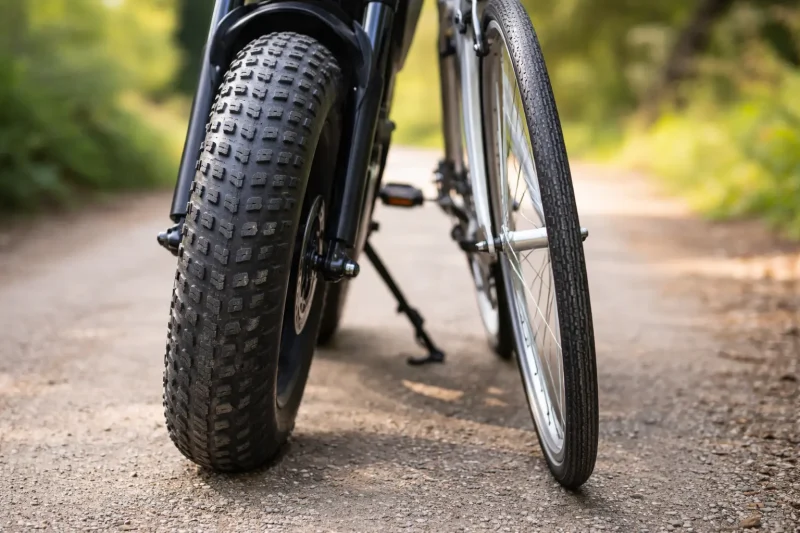
As a manufacturer for over two decades, I've seen many clients make this decision based on looks alone. This can be a costly mistake. The difference goes much deeper than just the width of the rubber on the wheel. It's about understanding two completely different product philosophies and market strategies. Let's break it down so you can make the right choice for your business and avoid common pitfalls.
When Should You Choose Regular Tires for Your E-Bike Line?
Worried about high shipping costs and targeting a practical audience? Fat tires might be too niche and expensive for your target customers, which could limit your market reach.
Regular tires are ideal for urban commuting, lightweight models, and price-sensitive markets. They offer lower rolling resistance, better battery efficiency, and are more affordable to manufacture and ship. They are the workhorses of the e-bike world, focused on practicality.
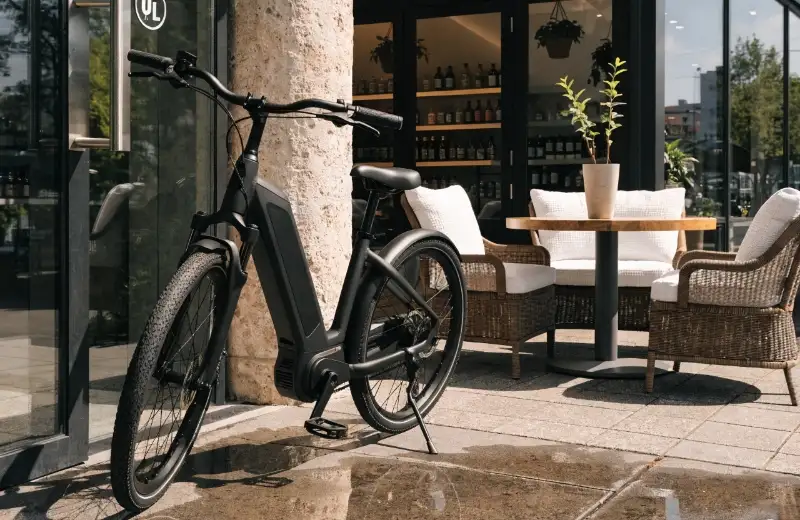
When we talk about regular tire e-bikes, we are talking about practical efficiency. These bikes are designed for a clear purpose: getting from point A to point B reliably and affordably. For your customers, this means a bike that is easy to handle, requires less effort to pedal, and gets more miles out of a single battery charge.
For you as an importer, wholesaler, or brand, the benefits are just as practical.
The Commuter's Choice: Efficiency and Cost
A regular tire e-bike is lighter. This isn't just a minor detail. A lighter bike means lower manufacturing costs, as less material is used.1 More importantly, it means significantly lower shipping and logistics costs. When you are shipping hundreds or thousands of units, that weight difference adds up quickly, directly impacting your bottom line. I remember a client from a dense European city who initially wanted a fat tire model. We prototyped it, but the shipping costs and final retail price were simply too high for his market. We switched to a slim, regular-tire city bike, and it became his bestseller because it met the real needs of his customers: efficiency and value.
Why It's the Safe Bet for Mass Markets
For price-sensitive markets, the regular tire is almost always the right answer. Your target customer is likely focused on fuel savings, avoiding traffic, and low maintenance. They are comparing your e-bike to a bus pass or a second car, not to a weekend toy.
Here is a simple breakdown:
| Feature | Regular Tire E-Bike | Fat Tire E-Bike |
|---|---|---|
| Ideal Use Case | Urban Commuting, Paved Roads | All-Terrain, Leisure, Off-Road |
| Rolling Resistance | Low | High |
| Battery Efficiency | Higher | Lower |
| Vehicle Weight | Lighter | Heavier |
| Shipping Cost | Lower | Higher |
| Market Position | Practical, Price-Sensitive | Lifestyle, High-Perceived-Value |
Choosing a regular tire isn't boring; it's a smart business decision for targeting the largest segment of the e-bike market. It sells practicality, and for millions of commuters, practicality is exactly what they want to buy.
Is a Fat Tire E-Bike the Right Way to Differentiate Your Brand?
Is your e-bike brand getting lost in a sea of similar-looking commuter models? It's hard to stand out when everyone seems to be selling the same basic design.
Absolutely. Fat tires offer a powerful visual impact that immediately sets a product apart.2 They create a sense of adventure and capability, making them perfect for building a memorable brand identity in the leisure, lifestyle, and premium market segments.
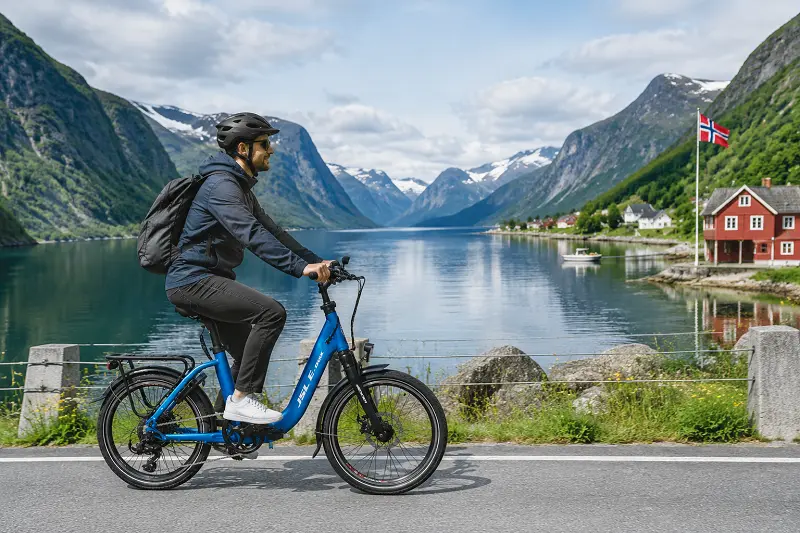
A fat tire e-bike doesn't just say, "I can get you to work." It screams, "Let's go on an adventure!" This is its greatest strength. The wide tires give the bike a strong, powerful look that grabs attention. For e-commerce sellers and brands that rely on visual appeal, this is a huge advantage. Your product will stand out in a crowded online marketplace or on a showroom floor. It creates what I call a "product memory point." People remember the bike that looks like it can go anywhere, whether it's on sand, snow, or a rugged trail.
But I always caution my clients: a fat tire is not just a cosmetic choice. It is a total system upgrade.
The Danger of a Simple "Tire Swap"
This is the single biggest mistake I see new brands make. They ask us to simply put fat tires on a standard commuter frame to save money. This never works. A fat tire is heavier and has much higher rolling resistance.3 If you don't upgrade the other components to match, you create a terrible riding experience.
I once worked with a new online seller who wanted to create a "cool" fat tire bike on a tight budget. We had to explain that without a more powerful motor, the bike would feel slow and sluggish. Without a larger capacity battery, the range would be disappointingly short. Without stronger hydraulic brakes, the heavier bike would be unsafe to stop. We helped them engineer a balanced system. It cost more upfront, but their brand is now known for its reliable performance, not for bad reviews.
A Complete System Upgrade
When you choose fat tires, you are committing to a higher-spec vehicle. You must consider:
- Motor: You need a motor with higher torque to overcome the increased resistance.
- Battery: A larger battery (higher watt-hours) is necessary to provide a decent range.4
- Brakes: Hydraulic disc brakes are essential for providing the stopping power needed for a heavier bike.5
- Frame & Fork: The frame and front fork must be stronger to handle the extra weight and the forces of all-terrain riding.6
A well-engineered fat tire e-bike is a fantastic product for the right market: leisure riders, suburbanites, and anyone looking to build a brand around fun and adventure.
How Do You Choose the Right Tire as an OEM/ODM Client?
Making a major product decision feels like a gamble. Choosing the wrong tire type can mean you've misjudged your entire market strategy before you even start selling.
It's not about choosing a tire; it's about defining your market strategy. For mass-market commuting and value, pick regular tires. For a niche, high-value, lifestyle brand, pick fat tires. Your choice here sets the direction for your entire product line.
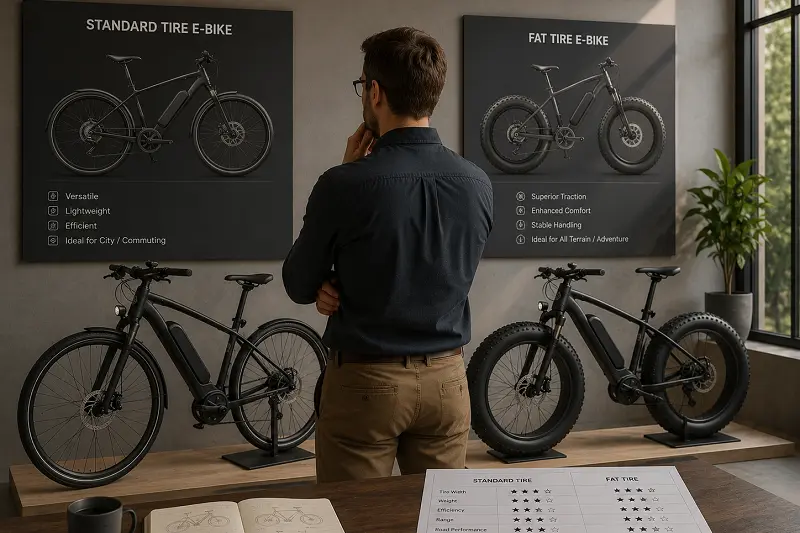
As your manufacturing partner, my goal is to help you build a successful product line. The tire choice is the first and most critical step because it defines who you are selling to and what your brand represents. You are choosing one of two paths: the mass-market commuter route or the high-perceived-value lifestyle route. Neither is better than the other, but trying to be both at once is a recipe for failure.
Step 1: Define Your Target Customer and Market
First, forget about the bike and think about your customer. Where do they live? What is their budget? Why are they buying an e-bike? If your customer lives in a crowded city and needs a practical, low-cost way to get to work, the answer is a regular tire e-bike. If your customer lives in the suburbs or a tourist town and wants a fun vehicle for weekend rides on trails or the beach, a fat tire e-bike is the clear winner. If you are an importer serving urban retailers, the logistics and price point of regular tire bikes make more sense. If you are an e-commerce brand building a community around adventure, a fat tire bike is your hero product.
Step 2: Align the Product with Your Brand Strategy
Your product must match your brand's story. A brand built on reliability, affordability, and eco-friendly commuting should feature sleek, efficient, regular-tire models. A brand built on freedom, exploration, and ruggedness needs the powerful visual statement of a fat tire e-bike.
Here is a simple checklist to help you decide:
| Ask Yourself... | If You Answer YES, Consider... |
|---|---|
| Is my target market price-sensitive? | Regular Tires |
| Is my main sales channel urban retail stores? | Regular Tires |
| Is efficiency and long range a key selling point? | Regular Tires |
| Do I want to build a lifestyle/adventure brand? | Fat Tires |
| Are my customers in suburbs or near trails/beaches? | Fat Tires |
| Is visual impact for online sales critical? | Fat Tires |
Ultimately, choosing a tire type is not about selecting a component. It is about deciding whether you want to sell practical efficiency or a memorable lifestyle experience. Once you make that strategic choice, the engineering and design decisions will naturally fall into place.
Conclusion
In short, regular tires sell practical efficiency, while fat tires sell a lifestyle and a memorable look. Your choice defines your entire market strategy from day one.
"Bicycle weight and commuting time: randomised trial - PMC - NIH", https://pmc.ncbi.nlm.nih.gov/articles/PMC2999990/. This source supports the claim that lighter bikes reduce manufacturing costs due to lower material usage. Evidence role: mechanism; source type: education. Supports: Lighter bikes reduce manufacturing costs due to lower material usage.. ↩
"Choice of Electric Bike Tires: Narrow or Fat? - Cyrusher E-Bikes", https://www.cyrusher.com/blogs/news/choice-of-electric-bike-tires-narrow-or-fat. This source supports the claim that fat tires are visually distinctive and contribute to brand differentiation in the e-bike market. Evidence role: general_support; source type: research. Supports: Fat tires are visually distinctive and contribute to brand differentiation in the e-bike market.. ↩
"Fat Bike Tires Test Results | Bicycle Rolling Resistance", https://www.bicyclerollingresistance.com/fat-bike-reviews. This source supports the claim that fat tires are heavier and have higher rolling resistance compared to regular tires. Evidence role: mechanism; source type: education. Supports: Fat tires are heavier and have higher rolling resistance compared to regular tires.. ↩
"21ah Fat Tire eBike Battery *Matte Black Only* - Bakcou", https://bakcou.com/products/21ah-fat-tire-ebike-battery?srsltid=AfmBOoqadottsXr4cyko6NzggMCTN_0Mr4TEOh83O-zkVlUy39SyEu9l. This source supports the claim that larger batteries with higher watt-hours are required for fat tire e-bikes to achieve a reasonable range. Evidence role: mechanism; source type: education. Supports: Larger batteries with higher watt-hours are required for fat tire e-bikes to achieve a reasonable range.. ↩
"Mechanical vs. Hydraulic Disc Brakes: A Comparison Guide", https://www.eriksbikeshop.com/blogs/expert-advice/mechanical-vs-hydraulic-disc-brakes?srsltid=AfmBOorLXJfqldhaJWMqO6TbTrpQn8CpBQqxWBe3WAZeUl2Eu5UF7IoW. This source supports the claim that hydraulic disc brakes are necessary for heavier bikes to ensure adequate stopping power. Evidence role: mechanism; source type: education. Supports: Hydraulic disc brakes are necessary for heavier bikes to ensure adequate stopping power.. ↩
"A Newbie's Guide to Fat Biking & Fat Tire Bikes - Bike Gear Database", https://www.bikegeardatabase.com/stories/newbies-guide-to-fatbiking. This source supports the claim that stronger frames and forks are required for fat tire e-bikes to handle additional weight and all-terrain forces. Evidence role: mechanism; source type: education. Supports: Stronger frames and forks are required for fat tire e-bikes to handle additional weight and all-terrain forces.. ↩