You're trying to choose a cargo e-bike for a 150kg load, but the torque numbers are confusing. Pick the wrong one, and you'll struggle up every hill and from every stop.
For a 150kg load, the right torque isn't one number. It depends on your riding conditions, the motor type, and the total weight. For flat city use, 80-100Nm1 is often enough. For hills and commercial delivery, you should look for 100Nm or much more.
The question "how much torque do I need?" is one I hear all the time. But from a manufacturer's point of view, it's not the right question to ask first. A simple Nm number on a spec sheet doesn't tell you the whole story. The real performance of a cargo e-bike comes from how the motor, the drivetrain, and the bike's design work together. To really understand what you need for a 150kg load, we need to look deeper than just one number. Let's break down what actually matters.
Is 80-100Nm Enough for City and Light Commercial Use?
You see many popular cargo e-bikes with motors around 85Nm. You wonder if that's enough for your 150kg load, or if it will feel weak and slow.
Yes, for most urban riding on flat roads with some small hills, 80-100Nm is a solid range. It provides enough power for daily starts and stops, even with a significant load. This is why motors like the Shimano EP82 (85Nm) are so common.
When we build bikes for city use, we know that most of the time they will be on relatively flat ground. In this situation, a motor in the 80–100Nm range is very effective. It gives you the boost you need to get going from a traffic light and helps you maintain speed without feeling like you're fighting the bike. Systems like the Shimano EP8 (85Nm) and the standard Bosch Cargo Line are designed for exactly this. They are reliable and provide smooth power for typical urban cargo tasks, like delivering groceries or carrying kids.
But this assumes the rest of the bike is well-designed. The wheel size, the gear ratios, and how the weight is distributed are all very important. A smaller wheel, for example, can make it easier to get a heavy load moving. So, while 80-100Nm is a good benchmark for light use, it is only part of a complete system.
Torque for Different Urban Scenarios
| Scenario | Load Type | Recommended Torque | Why? |
|---|---|---|---|
| Flat City Commute | Groceries, one child | 80-85Nm | Enough for starts and maintaining speed. |
| Light Commercial Delivery | Small packages, food | 85-100Nm | Handles frequent stops and starts better. |
| City with Rolling Hills | Heavier loads, two kids | 100Nm | Provides more confidence on slight inclines. |
When Should You Consider a Motor with 100-120Nm or More?
Your delivery route has steep hills and you have to stop and start all the time. An underpowered motor will make every start a chore and turn every hill into a problem.
You should look for a motor with 100-120Nm or more when your route involves moderate to steep hills3, or if you are doing frequent commercial deliveries. If the 150kg is purely cargo weight, then a motor with 120Nm or even 160Nm+ is the safer choice.
A cargo bike doesn't just need to cruise at speed. Its real test comes when it's fully loaded and has to start from a dead stop on a hill. This is where higher torque makes a huge difference. If the torque is too low, you don't just feel "slow." You feel like the bike is struggling. The motor gets hot, the battery drains quickly, and you have to work much harder. This is why Bosch upgraded its Cargo Line motor to offer more torque; they know that real-world commercial use is demanding. For frequent stops, moderate hills, and a total weight of 150kg, I would start looking at the 100-120Nm range.
Now, let's talk about a really heavy load. If the 150kg is just the cargo, you have to add the rider's weight (say, 80kg) and the bike's weight (around 40kg). The total system weight is now closer to 270kg. In this case, I wouldn't even consider an 85Nm motor. You need a true heavy-duty system. This is where motors like the Bafang M6204, which can deliver up to 170Nm, become necessary. They are built for these extreme loads.
Why is the Drivetrain More Important Than Just the Torque Number?
You're comparing two motors that both claim 100Nm of torque. You think they will perform the same, but one could leave you struggling while the other climbs hills easily.
A motor's torque number is only one part of the equation. The drivetrain, especially if it's a mid-drive or hub motor, is what determines how well that power is actually used. A mid-drive motor uses the bike's gears to multiply torque for better climbing.
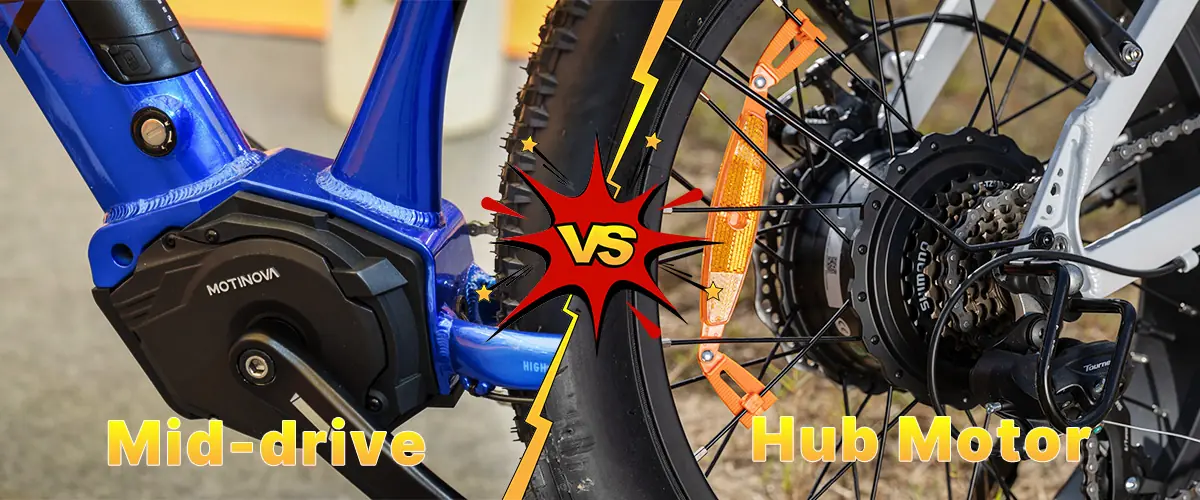
This is the point that many customers miss. Having 100Nm of torque is great, but that power has to get to the ground effectively. This is where the type of motor and the bike's gearing come in.
A mid-drive motor is located in the middle of the bike, where the pedals are. It sends power through the chain to the rear wheel. This means the motor can use the bike's gears. When you shift to an easy gear to climb a hill, the motor gets the same advantage. This multiplies the torque, making it much easier to start from a stop and climb steep hills with a heavy load.
A hub motor is located in the center of the front or rear wheel. It powers the wheel directly. This system is simpler, but it cannot use the bike's gears to multiply its torque. As a result, hub motors can struggle on steep hills with a heavy load. They can also overheat more easily under constant strain.
If a customer asks me for a recommendation, I first ask three questions:
- Is the 150kg the total weight, or just the cargo?
- Will you be riding on flat roads or climbing hills?
- Is this for occasional use or for daily, high-frequency commercial work?
The answers change everything.
Mid-Drive vs. Hub Motor for Cargo
| Feature | Mid-Drive Motor | Hub Motor |
|---|---|---|
| Starting Power | Excellent, uses gears to multiply torque. | Good, but can struggle with very heavy loads. |
| Climbing Ability | Excellent, ideal for hilly areas. | Fair, can overheat on long, steep climbs. |
| Efficiency | Very efficient, especially when using gears. | Less efficient under heavy load and on hills. |
| Best Use Case | Heavy loads, commercial use, hilly terrain. | Lighter loads, flat terrain, city commuting. |
Conclusion
For a 150kg cargo e-bike, you don't need a single torque number. You need a complete power system matched to your specific needs for starting, climbing, and long-term use.
Explore this link to understand why 80-100Nm torque is often sufficient for flat city riding with a cargo e-bike. ↩
Learn about the Shimano EP8 motor, a popular choice for urban cargo e-bikes, and why it's effective for city use. ↩
Understand the importance of higher torque for cargo e-bikes when navigating steep hills. ↩
Explore the Bafang M620 motor, known for its high torque output, ideal for extremely heavy cargo loads. ↩