Struggling to choose the right brakes for an e-bike? The wrong choice can affect your safety and electric bike's health. We'll help you understand the key differences simply. For most electric bikes, disc brakes1 are the superior choice. They offer stronger, more consistent braking power2 in all weather conditions, especially wet and muddy ones. This is crucial for the higher speeds and weight of e-bikes, ensuring your safety and protecting your wheel rims from wear.
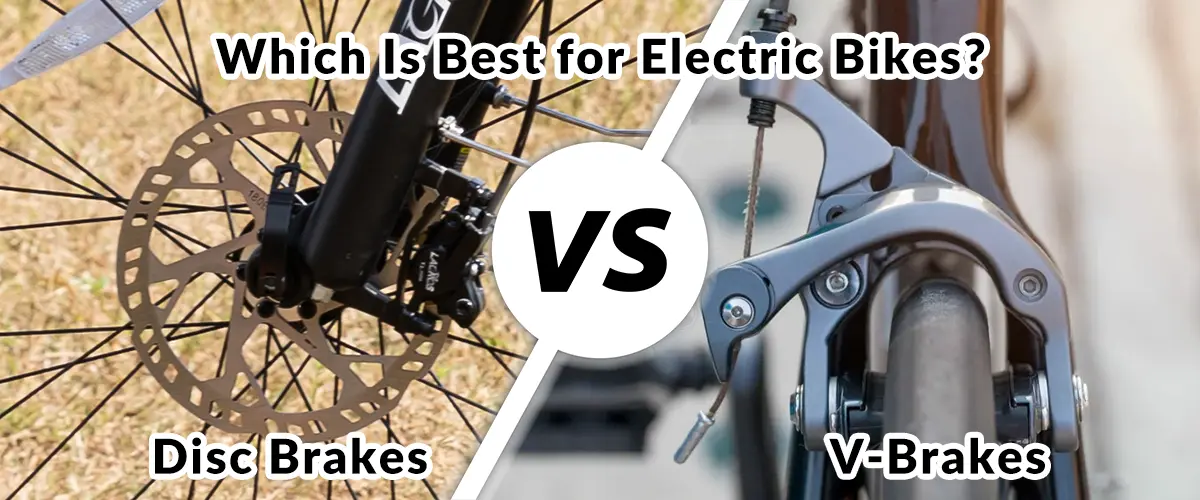
Choosing the right brake system3 for an electric bike is one of the most important decisions you can make. It's not just about stopping; it's about stopping safely and reliably, every single time. As a manufacturer, we've tested and installed dozens of brake systems, and we see the real-world results. Let's break down the two main options you'll encounter so you can see why one has become the standard for modern e-bikes. This will help you make a smart choice for your next bike or your product line.
What Are Rim Brakes and How Do They Work?
Worried about brake maintenance4 and cost? Rim brakes seem simple and cheap, but their performance in wet weather can be a real safety concern5 on a heavy e-bike. Rim brakes are a traditional system that works by a cable pulling two brake pads6 against the rim of your wheel. This friction slows you down. They are simple to understand, easy to maintain, and very cost-effective, which is why they were popular for a long time.
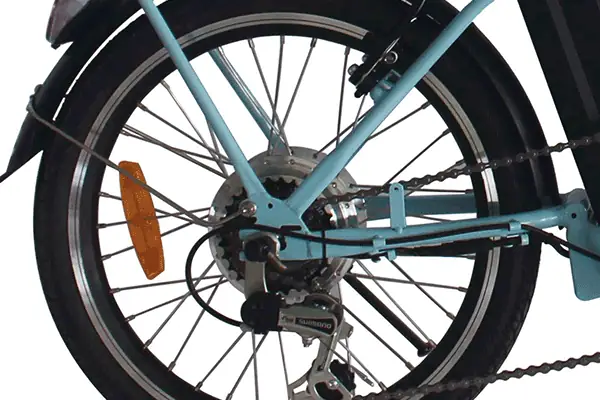
Let's dive deeper into how rim brakes7 function. The system is purely mechanical. When you pull the brake lever8, it pulls a steel cable. This cable runs along the bike frame and connects to the brake calipers. The calipers are the arms that hold the brake pads. The pulling force from the cable squeezes the calipers, pressing the rubber brake pads directly onto the flat braking surface9 of your wheel's rim. The friction between the pads and the rim is what stops the bike. This design has some clear advantages, especially from a cost and maintenance perspective.
Key Characteristics of Rim Brakes
| Feature | Description | Implication for E-Bikes |
|---|---|---|
| Mechanism | Pads press on the wheel rim. | Simple, easy to visually inspect. |
| Cost | Generally much cheaper than disc brakes. | Lowers the overall cost of the bike. |
| Maintenance | Easy to adjust and replace pads. | Most cyclists can perform maintenance at home. |
| Weakness | Poor performance in wet or muddy conditions. | A significant safety risk for heavier, faster e-bikes. |
| Wear | Gradually wears down the wheel rim itself. | The rim is a structural part; replacing it is expensive. |
Because water and dirt on the rim act as a lubricant, rim brakes lose a lot of their stopping power in the rain. For a lightweight, traditional bicycle, this might be manageable. But for an electric bike, which is heavier and often travels at higher speeds, this loss of performance is a serious safety issue. That's why we rarely recommend them for anything other than the most basic, fair-weather city e-bikes.
Why Are Disc Brakes the Standard for Modern E-Bikes?
Do you ride your e-bike in all conditions, including rain? Rim brakes can fail you when wet, but disc brakes provide consistent, powerful stopping you can trust, no matter the weather. Disc brakes work by squeezing a brake pad against a metal rotor mounted to the center of the wheel hub. This system is not affected by water on the rim and provides far superior braking force10, making it the safest and most reliable option for e-bikes.
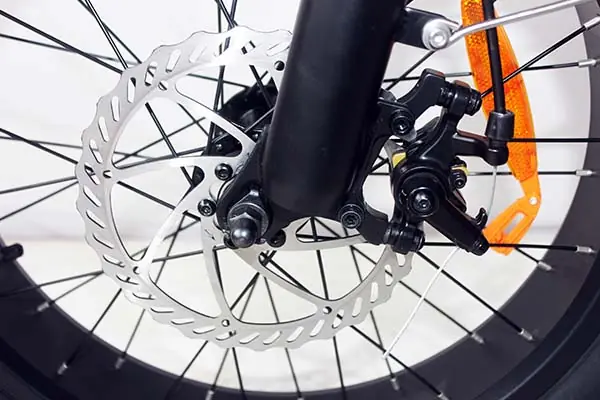
Disc brakes have completely changed the game for cycling, especially for electric bikes. The entire system is moved away from the rim to the hub of the wheel. A dedicated metal disc, called a rotor, is bolted to the hub. A device called a caliper is mounted to the bike's frame or fork. When you pull the brake lever, the caliper squeezes brake pads onto the spinning rotor, creating powerful friction that stops the wheel. This design solves the biggest problems of rim brakes. Since the braking surface is the rotor, not the rim, your wheels are safe from wear and tear. More importantly, the system is much less affected by rain, mud, or dirt. In our factory, we almost exclusively use disc brakes for this reason. We categorize them into two main types:
1. Mechanical Disc Brakes
These use a steel cable to activate the caliper, just like rim brakes. They are an affordable upgrade from rim brakes and offer better all-weather performance11. However, the feel can sometimes be a bit spongy, and they require manual adjustment as the pads wear down.
2. Hydraulic Disc Brakes
This is the top-tier system and our most used type. Instead of a cable, they use a sealed system filled with hydraulic fluid. When you pull the lever, it pushes fluid through a hose, which forces the pistons in the caliper to clamp the pads onto the rotor. This gives you a much lighter lever feel and significantly more braking power. The system is self-adjusting as the pads wear. We use hydraulic disc brakes12 on everything from city commuters to heavy-duty cargo e-bikes because their reliability is unmatched.
How Do Mechanical and Hydraulic Disc Brakes Compare?
Thinking about disc brakes but confused by the options? Mechanical seems cheaper, but hydraulic offers much better performance. Is the extra cost for hydraulic brakes really worth it for you? Yes, for almost every e-bike rider, hydraulic disc brakes are worth the extra cost. They provide superior stopping power with less hand effort, are self-adjusting, and offer better modulation, giving you more precise control over your braking. This translates directly to a safer and more confident ride.
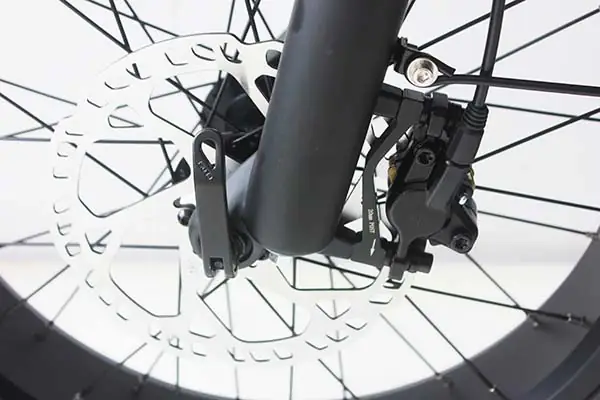
While both types of disc brakes are a big step up from rim brakes, there are important differences between mechanical and hydraulic systems. As a manufacturer, we have to weigh these factors carefully when designing a new e-bike line for our OEM clients. The choice directly impacts performance, price, and maintenance needs. A mechanical disc brake is a good middle ground. It's reliable and offers decent stopping power. The main advantage is its simplicity and low cost. The downside is that the braking force is limited by the friction in the cable, and you have to manually turn a knob or dial to adjust for pad wear. A hydraulic disc brake is a more advanced, closed system. The hydraulic fluid transfers your force from the lever to the caliper much more efficiently than a cable can. This means you get more stopping power for the same amount of effort. This is called "leverage." It also gives you better "modulation," which means you can more finely control the amount of braking force, from a gentle slowdown to a full emergency stop. Here is a simple breakdown we use when consulting with clients:
| Aspect | Mechanical Disc Brakes | Hydraulic Disc Brakes |
|---|---|---|
| Power | Good | Excellent |
| Control (Modulation) | Fair | Excellent |
| Hand Effort | Medium to High | Very Low |
| Maintenance | Manual pad adjustment, cable replacement. | Self-adjusting pads, requires periodic fluid "bleeding". |
| Cost | Lower | Higher |
| Best For | Budget-conscious e-bikes, entry-level models. | Performance, all-terrain, cargo, and premium e-bikes13. |
While hydraulic systems require a specialized "bleeding" procedure to replace the fluid every year or two, their day-to-day performance and self-adjusting nature make them far more user-friendly and, most importantly, safer. For a heavy cargo e-bike carrying a load or a mountain e-bike descending a steep trail, that extra power and control is not a luxury—it's a necessity.
Conclusion
In summary, disc brakes, especially hydraulic ones, are the best choice for e-bikes due to their superior power, reliability in all weather, and overall safety for heavier, faster bikes.
Explore the advantages of disc brakes, especially for e-bikes, ensuring safety and performance in all conditions. ↩
Understand the importance of braking power for safety and performance in electric bikes. ↩
Learn about the best brake systems for e-bikes to ensure safety and reliability. ↩
Get tips on maintaining your e-bike brakes for optimal performance and safety. ↩
Explore the safety risks associated with rim brakes, especially in wet conditions. ↩
Understand the importance of timely brake pad replacement for safe riding. ↩
Learn about the limitations of rim brakes and why they may not be suitable for heavier e-bikes. ↩
Learn how the design of the brake lever influences braking efficiency and control. ↩
Discover how the braking surface impacts performance and safety in e-bikes. ↩
Understand the concept of braking force and its critical role in e-bike safety. ↩
Explore the importance of all-weather performance in choosing e-bike brakes. ↩
Find out why hydraulic disc brakes are preferred for their performance and reliability. ↩
Discover the features that make premium e-bikes stand out, including brake systems. ↩