Are you worried about e-bike batteries failing in the extreme heat1 of the Middle East? The real problem isn't what you think. It's a silent killer that affects performance and longevity.
The biggest battery challenges in high-heat markets like the Middle East aren't just about reduced range. The real issues are accelerated long-term aging, severe charging restrictions, and unstable power output. It’s a test of the entire e-bike system, not just the battery's capacity.
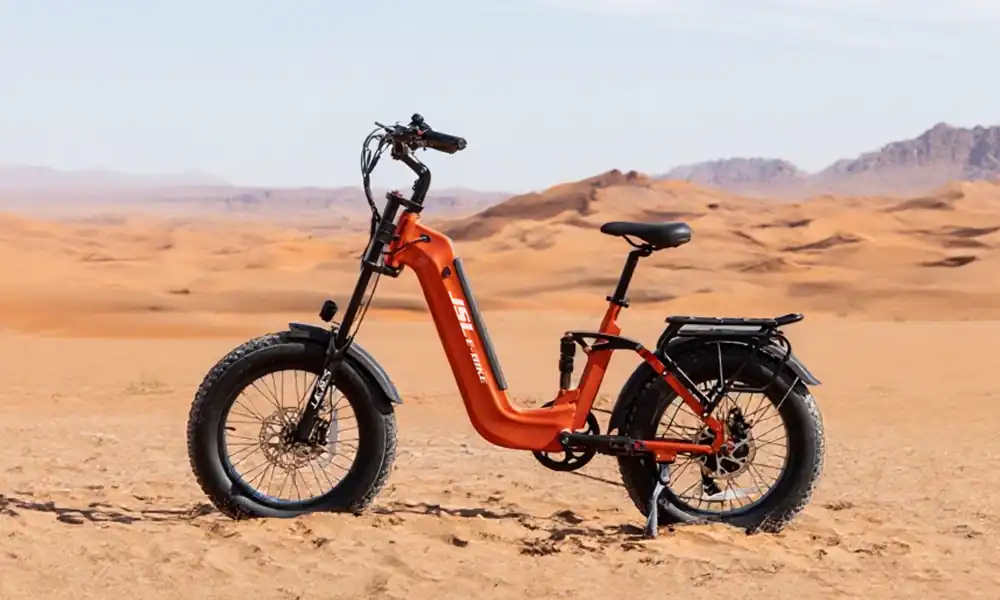
When we talk with clients about markets like the Middle East, the conversation often starts with battery range. That makes sense. But after over 20 years in this business, I've learned that focusing only on range is a mistake. The extreme heat introduces a whole different set of problems that are far more critical. It’s not about if the bike will run today, but for how many seasons it will remain reliable. We need to shift our focus from simple capacity to overall system resilience. Let's dive into what really happens to an e-bike battery when the temperature soars.
Is Immediate Failure the Biggest Battery Risk in Hot Climates?
You might think an e-bike battery will just stop working on a scorching hot day. The real danger, however, is a much slower and more costly process that ruins your investment over time.
No, the biggest risk isn't the battery dying suddenly. It's the rapid, premature aging of the battery cells. High heat dramatically shortens the battery's overall lifespan, even if it seems to perform adequately from one day to the next. You're losing future performance, not today's ride.
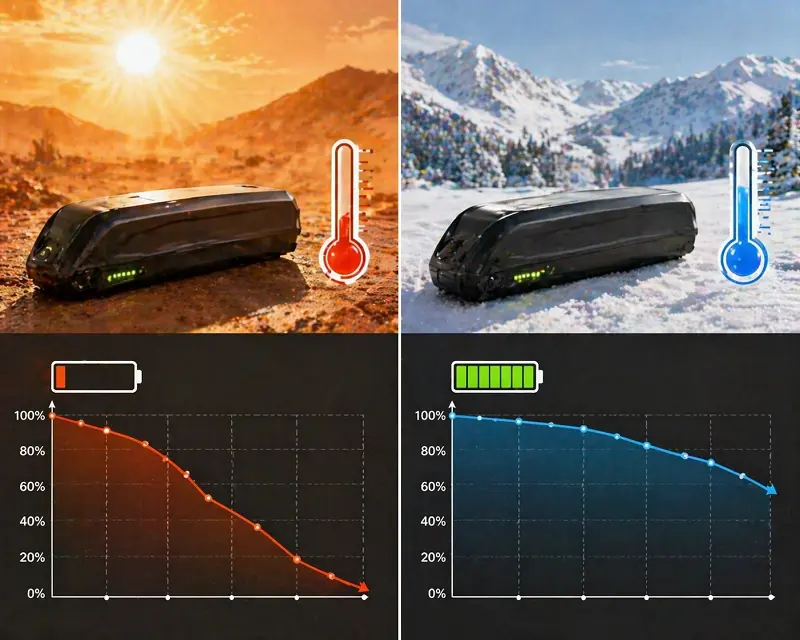
I remember a client from Dubai who was confused. His fleet of e-bikes was working, but the batteries were losing their charge capacity way faster than his European fleets. He thought he had a bad batch of batteries. In reality, his batteries were suffering from a problem we see all the time in hot climates: accelerated degradation.
The battery doesn't just "break." Instead, the extreme heat speeds up the chemical reactions inside the lithium-ion cells, causing them to age prematurely. This means:
- Faster Capacity Loss: A battery that should last for years might lose a significant portion of its capacity in just one season.
- Reduced Long-Term Health: The battery’s ability to hold a full charge and deliver consistent power diminishes much more quickly.
The issue isn't a single day of failure; it's the entire lifespan being "eaten away" by the heat.
| Common Expectation in Hot Climates | The Reality of Battery Performance |
|---|---|
| The bike will stop working. | The bike runs, but the battery ages faster. |
| Range is the only thing that drops. | Overall battery lifespan is shortened. |
| It's a defect if it fails early. | It's a predictable result of heat exposure. |
Why Does High Heat Make Charging Your E-Bike So Difficult?
You’ve finished your ride and want to plug in your e-bike to get it ready for the next one. But in the Middle East, the heat itself can prevent you from charging at all.
High ambient temperatures often push batteries beyond their safe charging limits. Top-tier systems like Bosch's will automatically prevent charging above 40°C (104°F) to protect the cells. This means you first have to cool the battery down before you can even start charging.
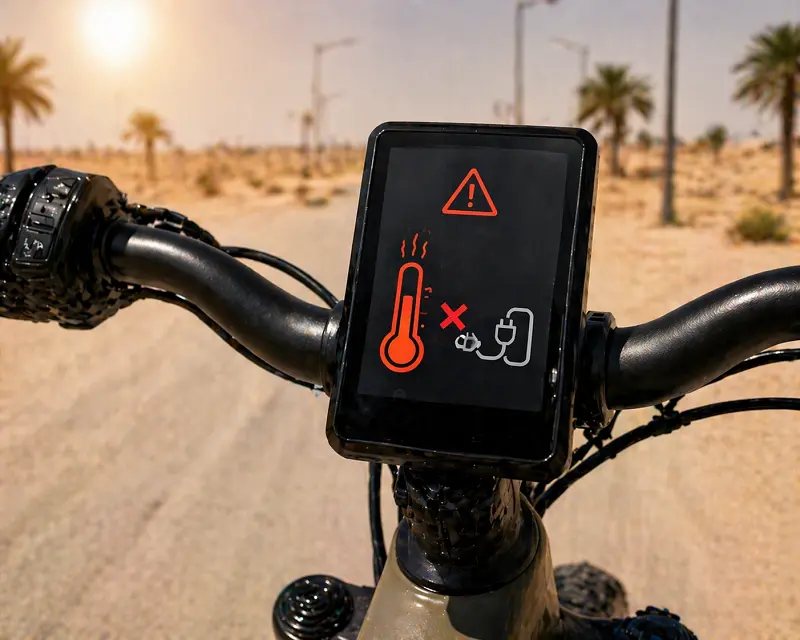
This is a critical point that many people overlook. It’s not just a recommendation; it’s a built-in safety feature. For example, Bosch's official documentation2 is very clear: the battery management system (BMS) will report a temperature error and block charging if the battery is too hot or too cold. In a climate where temperatures in a garage, warehouse, or outdoor rental point can easily exceed 40°C, this isn't a small problem. It's a daily operational hurdle.
From our perspective as a manufacturer, this changes everything. We aren't just designing for high riding temperatures; we must design for the entire ownership experience, especially the charging environment. This means considering:
- User Education3: Customers need to understand that they can't just leave a battery to charge in a hot car or a sun-baked shed.
- BMS Programming4: The BMS must be robust enough to protect the battery without creating constant user frustration.
- System Integration5: The design must help the battery cool down, not trap more heat around it.
This limitation shows that in hot markets, ensuring safe and stable charging is just as important as performance on the road.
Does a Bigger Battery Mean Better Performance in the Heat?
When faced with performance issues, the most common request we get is for a bigger battery with more amp-hours (Ah) or watt-hours (Wh). But in extreme heat1, simply adding capacity is like putting a bigger fuel tank on a car with an overheating engine. It doesn't solve the core problem.
Not at all. In extreme heat, performance stability is far more critical than raw capacity. A large battery will still suffer from faster power drain and trigger its self-protection mode earlier, leading to unstable and unpredictable performance under thermal stress.
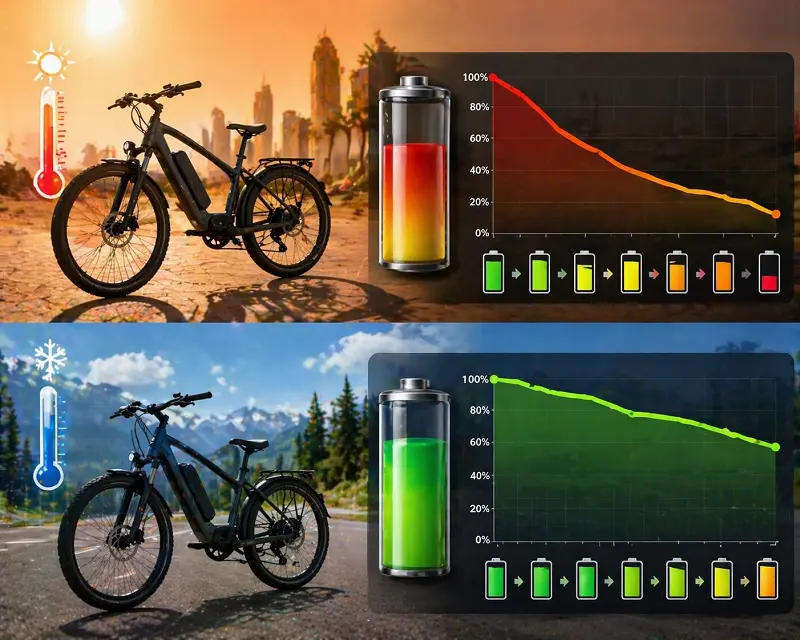
Imagine a delivery rider in Riyadh on a hot afternoon. The air is hot, the bike is carrying a heavy load, and the rider is constantly starting and stopping in traffic. This combination puts immense thermal pressure on both the battery and the control system. Even if the battery isn't about to fail, you'll see other issues appear:
- Power Drains Faster: The battery meter seems to drop much more quickly than expected.
- Protection Kicks In: The BMS will reduce power output to prevent overheating, making the bike feel sluggish, especially on hills.
- Inconsistent Output: The ride feels jerky or weak because the system is constantly trying to manage heat.
In this scenario, what the rider needs is not a battery that is theoretically bigger, but one that remains stable under pressure. When we evaluate batteries for hot markets, we are looking at their high-temperature stability, not just their sticker numbers.
| Metric | Why It's Misleading in Heat | What Really Matters |
|---|---|---|
| Capacity (Ah/Wh) | A big number doesn't guarantee stable output under thermal load. | Stability Under Load |
| Peak Power (W) | BMS will limit power to prevent overheating anyway. | Consistent Power Delivery |
| Nominal Range | Unachievable when heat causes efficiency to plummet. | Real-World Usable Range |
How Should We Approach E-Bike Design for Hot Markets?
If you want to enter a market like the Middle East, you might be tempted to just spec a larger battery and call it a day. From my experience, I can tell you that this approach is a direct path to after-sales headaches and brand damage.
The right approach is to treat "thermal management" as a core, integrated feature, not an afterthought. This involves a holistic design where the battery cells, BMS, frame ventilation, and user guidance all work together to manage heat effectively.
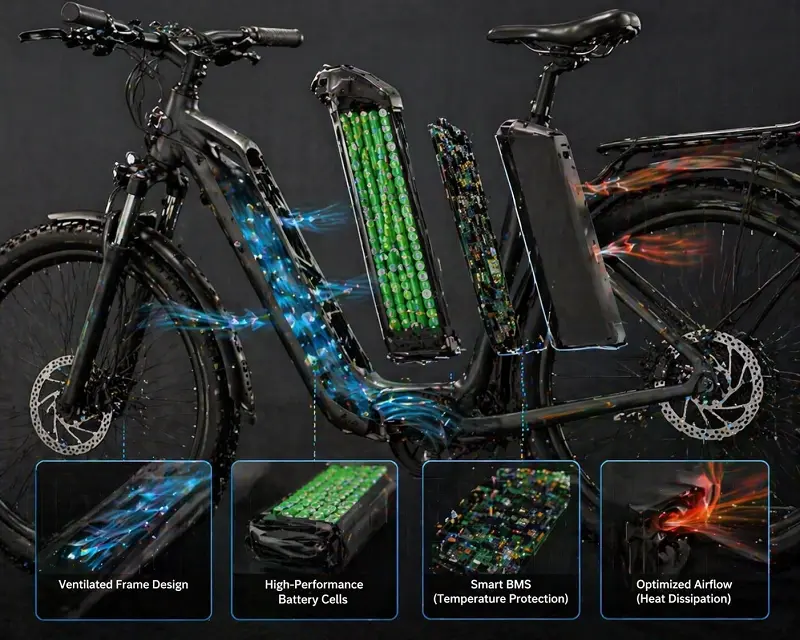
Selling e-bikes in the Middle East isn't about selling battery capacity; it's about selling the entire system's ability to tolerate extreme heat. This is a fundamental shift in thinking. At our factory, this means we look at the project as a complete system, including:
- Battery & BMS Quality6: Using high-quality automotive-grade cells that are inherently more stable at high temperatures, paired with a sophisticated BMS programmed for heat protection.
- Battery Compartment Design: The location and design of the battery housing are crucial. It needs to allow for airflow and not be a "heat trap" that makes the problem worse.
- Frame Integration: The frame itself can help or hinder heat dissipation. We design frames that don't accumulate heat around critical components.
- User Guidance & Storage: We must also educate the end-user. Simple advice, like Bosch's recommendation to store batteries between 0°C and 20°C at 30-60% charge, becomes a fundamental rule for battery longevity in hot climates.
This isn't about just choosing a different battery from a catalog. It's about deep, integrated engineering.
Conclusion
For hot markets like the Middle East, success isn't about winning on battery specs. It's about delivering a reliable system that manages heat, protects the battery, and provides a consistent user experience.
Explore the impact of high temperatures on battery performance and longevity to better protect your investment. ↩
Gain insights from Bosch's guidelines to ensure safe and efficient charging of your e-bike battery. ↩
Learn how educating yourself about battery care can enhance the performance and lifespan of your e-bike. ↩
Understand the role of Battery Management System programming in maintaining battery health and performance. ↩
Explore how integrated design can improve e-bike performance and battery longevity in hot climates. ↩
Learn how high-quality components contribute to better performance and longevity of e-bike batteries. ↩